PreviewPhoto-style images are generatedPlates are drafts awaiting expert reviewCheckout isn’t open yet

Hometown Field Guidesby Garden with Lilly

Austin Edition, $17

No. 1 · The Austin Edition

Raise your first monarch, from egg to release, in your own Austin yard

No kit. No mail-order caterpillars. The native plants monarchs look for, when to plant them, and what to do when the first caterpillar turns up.

An illustrated guide and a printable journal for your child.

This edition covers Travis, Williamson, Hays, Bastrop and Caldwell counties.

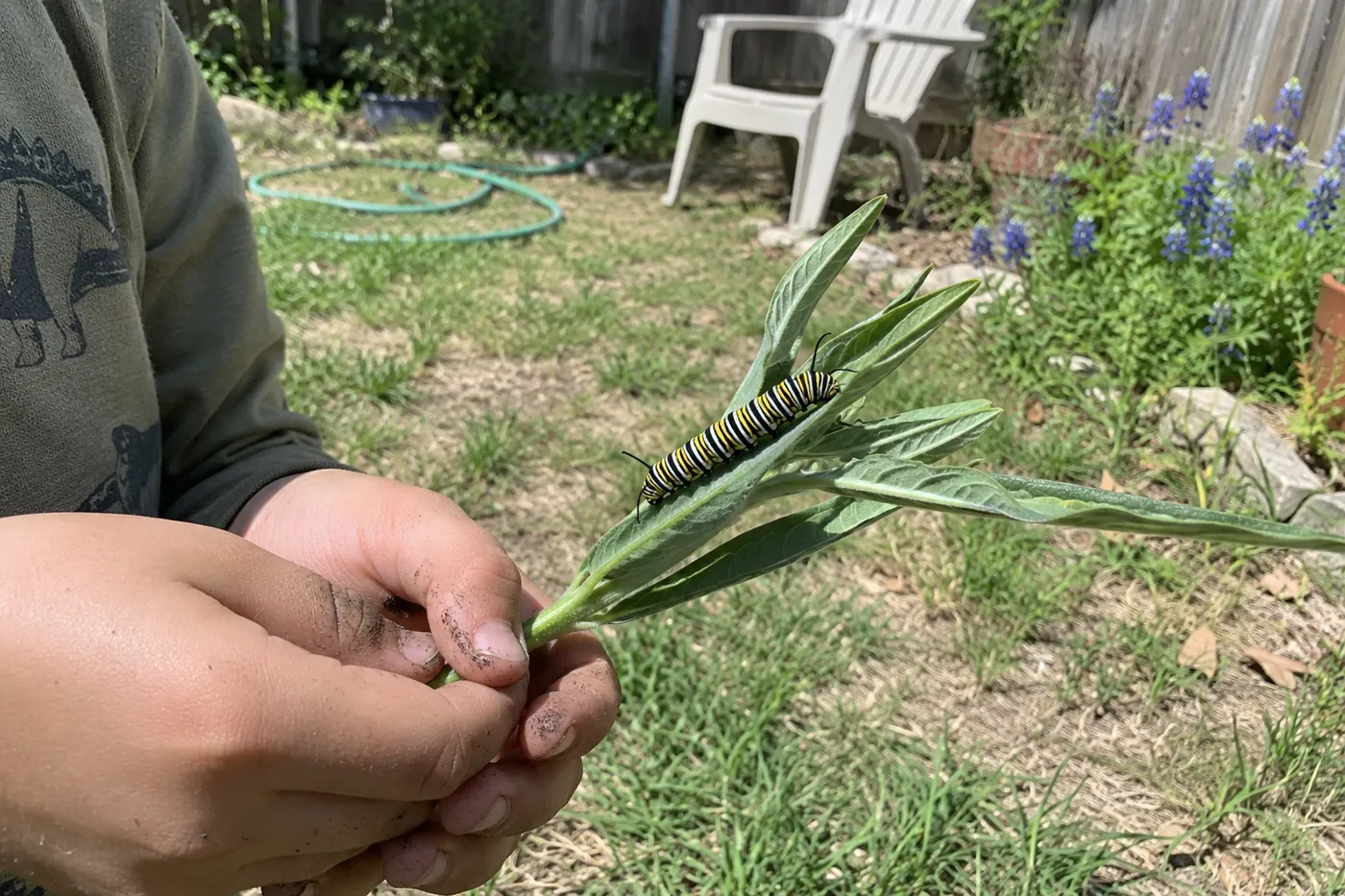
A child's cupped hands holding a sprig of narrow-leaved milkweed with a striped monarch caterpillar on it, in a backyard with bluebonnets and a garden hose.
A caterpillar in small handsGenerated image, not a photograph
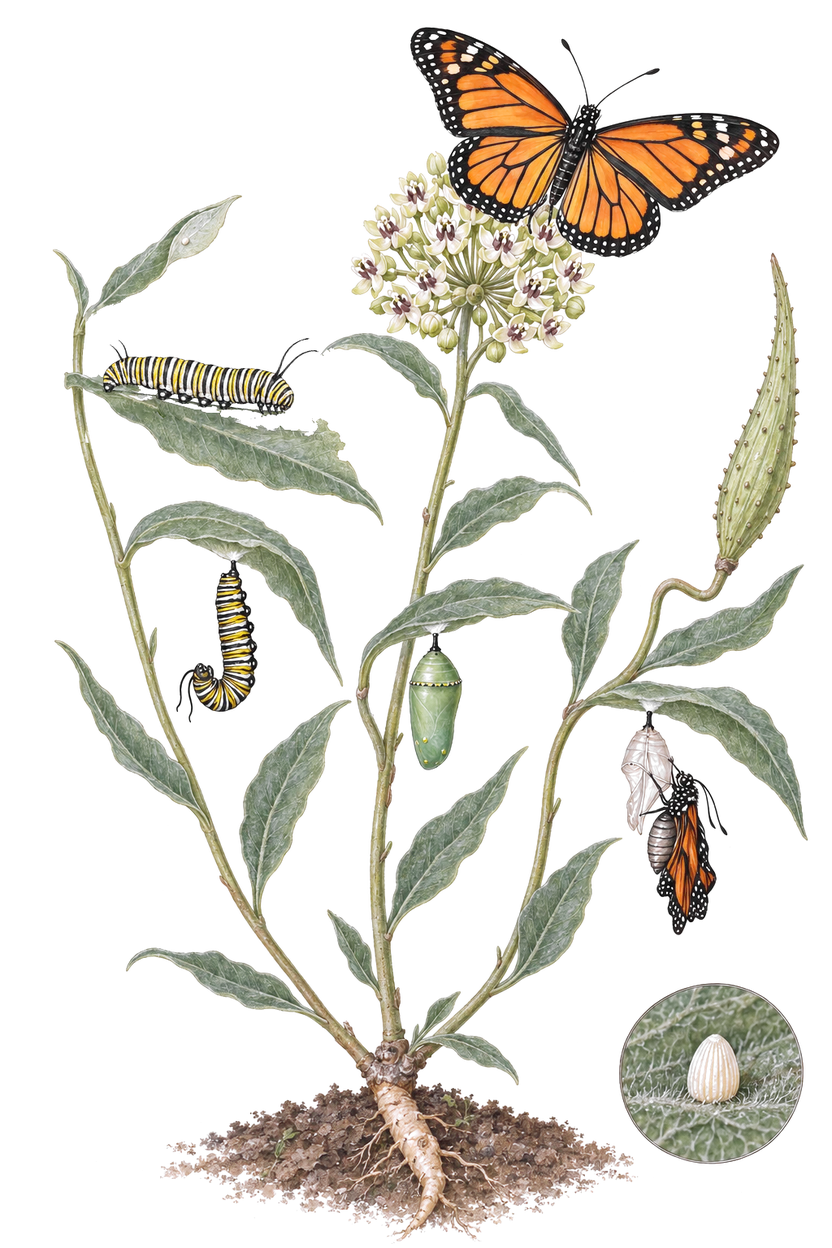
A watercolor plate of one antelope horns milkweed plant with the whole monarch life cycle on it: a tiny cream egg on a curled leaf tip near the top, a full-grown caterpillar eating a chewed leaf, a caterpillar hanging head-down in a J, a green chrysalis with gold dots, an empty chrysalis case with a new butterfly hanging below it to dry its wings, a butterfly with open wings feeding on the round flower cluster, a curved seed pod, the taproot, and the egg shown enlarged in a circle.

Plate I

The whole life cycle, drawn on one plant

Egg, caterpillar, chrysalis and butterfly, all on antelope horns milkweed, the way Maria Sibylla Merian composed her plates in 1705. The guide is illustrated like this throughout: accurate enough to tell a small caterpillar from a big one, and lovely enough to leave open on the table.

Can you find the egg on a curled leaf tip, the big caterpillar eating, the one hanging in a J, the green chrysalis, the new butterfly drying its wings, and the mother feeding? The egg is in the circle too, much bigger than life.

Draft, awaiting expert review. Every plate that identifies a living thing is reviewed by a lepidopterist or a horticulturist before the guide ships.

Monarchs come through Austin twice a year. Spring is egg season

Every spring and fall, monarchs cross Texas on the way between Mexico and the north. Which visit your yard is ready for decides whether you see eggs and caterpillars, or butterflies stopping to feed.

  • Main egg season, about mid-March to mid-April
  • Passing through, late September to early November
  • The busiest three weeks
  • Sow milkweed seed: fall, says the Native Plant Society of Texas

Where the monarchs are right nowIn spring they lay eggs here. In fall most only pass through.

About mid-March to mid-April

Egg season

Monarchs flying north from their winter forests in Mexico stop on Texas milkweed to lay their eggs, and then they die. Their children carry on north. This is the visit the guide is built around, and the one your milkweed has to be ready for.

Texas Parks and Wildlife: “Seeking emerging milkweeds, they move through Texas laying eggs before dying.” Eggs were recorded at Driftwood, one county over, on 12 March 2025 (Journey North).
Late September to early November

Passing through

Most fall monarchs are on their way to Mexico and aren’t laying eggs, though a smaller wave of caterpillars does turn up in fall. What the travelers need from your yard is flowers to feed on for the long flight. The busiest three weeks are usually mid-October to early November.

Texas Parks and Wildlife for the passage; Monarch Joint Venture on why most fall monarchs don’t breed; Scott and colleagues (2022) on fall breeding in north Texas; the busiest weeks from iNaturalist sightings in Travis County, 2023 to 2025, which also reflect when people are out looking.

Three to five weeks, from egg to butterfly

Here is what your family will see, and roughly when. The day counts are for warm weather; in a cool spring, each stage can take longer.

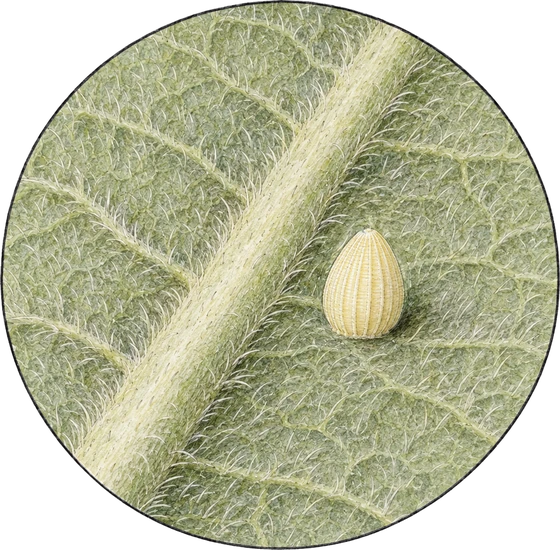
A monarch egg enlarged inside a circle: a pale cream egg with fine ridges from base to tip, glued to a hairy green milkweed leaf beside its midrib.

Monarch egg, enlarged1.2 mm tall, 0.9 mm wide

Stage 1 · about days 1 to 4

A cream-colored dot under a leaf

She usually lays one egg at a time, often on the underside of a leaf near the top of the plant. Each egg is about the size of a pinhead. Hand the kids a magnifying glass, turn the leaves over together, and let them be the ones to find it.

Hatches in 3 to 5 days, depending on the temperature. Monarch Joint Venture.

Stage 2 · about days 4 to 16

Nine to fourteen days of eating

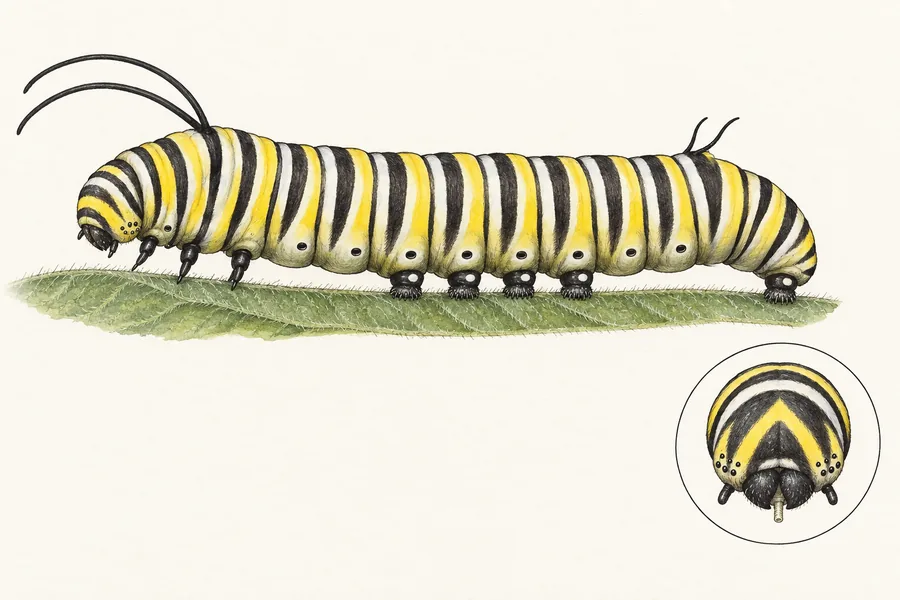
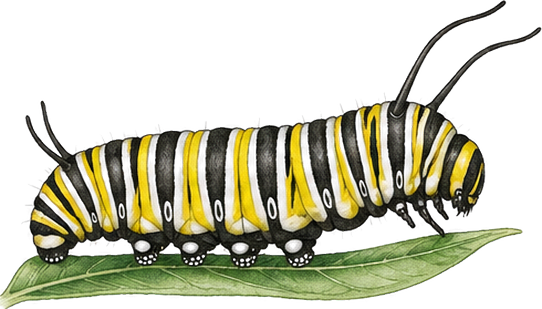
Its first meal is its own eggshell. After that it eats milkweed, only milkweed, and it grows so fast it splits its skin and sheds it four times. Each size in between is called an instar.

Lengths and days for each instar: Monarch Joint Venture.

Five sizes of one caterpillar

Drawn to scale. Slide to grow it.

Instar 1 · 2 to 6 mm · 1 to 3 days. Pale green or grayish-white, shiny, almost see-through.
A child's cupped hands holding a sprig of narrow-leaved milkweed with a striped monarch caterpillar on it, in a backyard with bluebonnets and a garden hose.
Checking on it after schoolGenerated image, not a photograph

Most of what the guide covers happens in this stage: how much milkweed a few caterpillars eat, what to do if the plant runs out, and the pests to watch for.

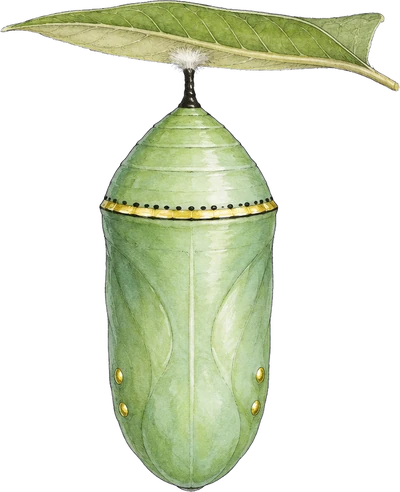
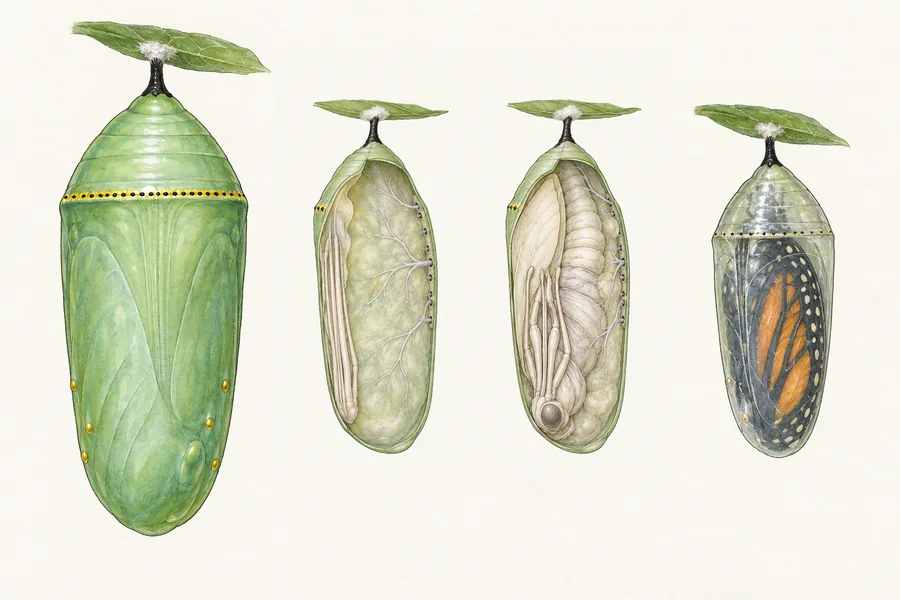
A jade-green monarch chrysalis hanging by a short black stalk from a white silk pad under a leaf, with a band of gold dots near the top.

Chrysalis8 to 15 days

Stage 3 · about days 16 to 27

Then it goes for a walk

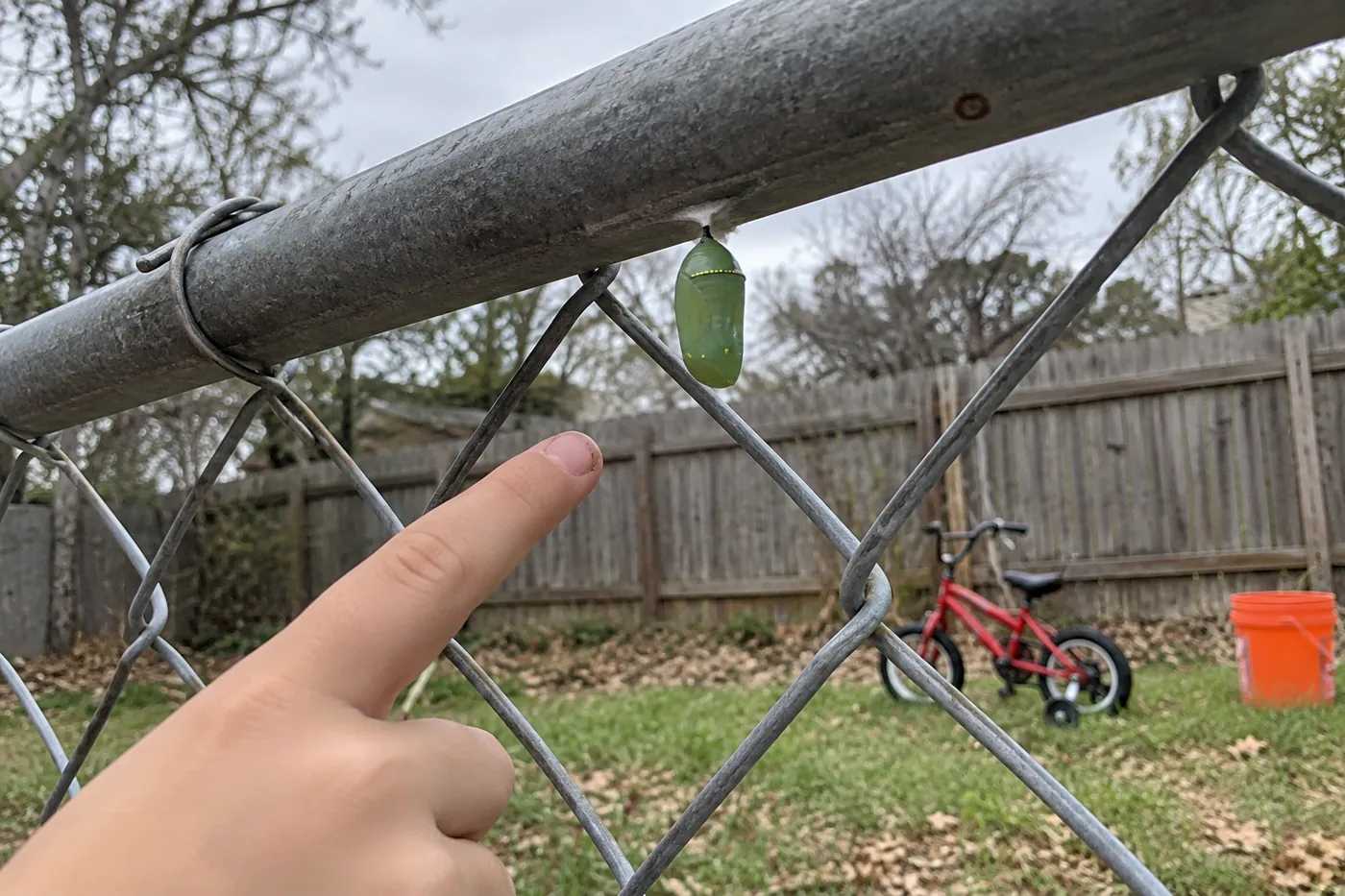
A full-grown caterpillar often leaves the milkweed and travels a surprising way to find somewhere to hang: a fence rail, the window trim, the underside of a patio chair. It spins a silk pad, hangs upside down in the shape of a J, and sheds its skin one last time. Underneath is a bright green chrysalis.

Near the end, the wings show through: black, orange and white, folded up inside. That’s the day to keep the kids close.

Monarch Joint Venture.

A green monarch chrysalis hanging under the top rail of a chain-link fence on an overcast day, with a child's finger pointing at it from a short distance away.
Under the fence railGenerated image, not a photograph
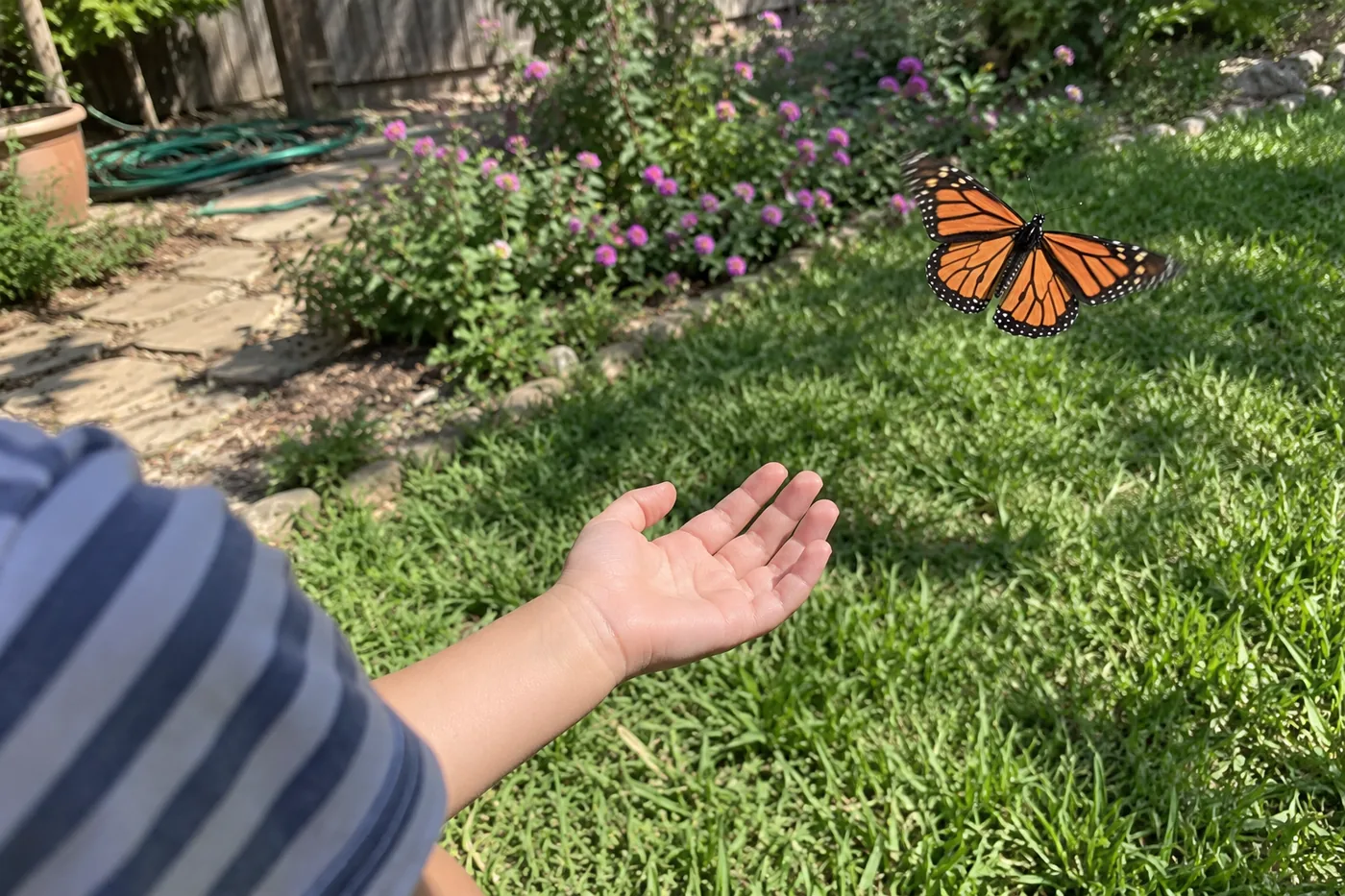
In daylight, a monarch butterfly flies up and away from a child's still, open palm, over a backyard lawn with a flowering shrub, a stone path and a coiled garden hose.
Generated image, not a photograph

Stage 4 · about day 27, give or take a week

And one day, you let it go

A new butterfly pumps its crumpled wings open, then needs several hours to dry before it can fly. Get the camera ready. When it’s ready, it goes, and a child who has checked on it every day for a month gets to watch.

Monarch Joint Venture.

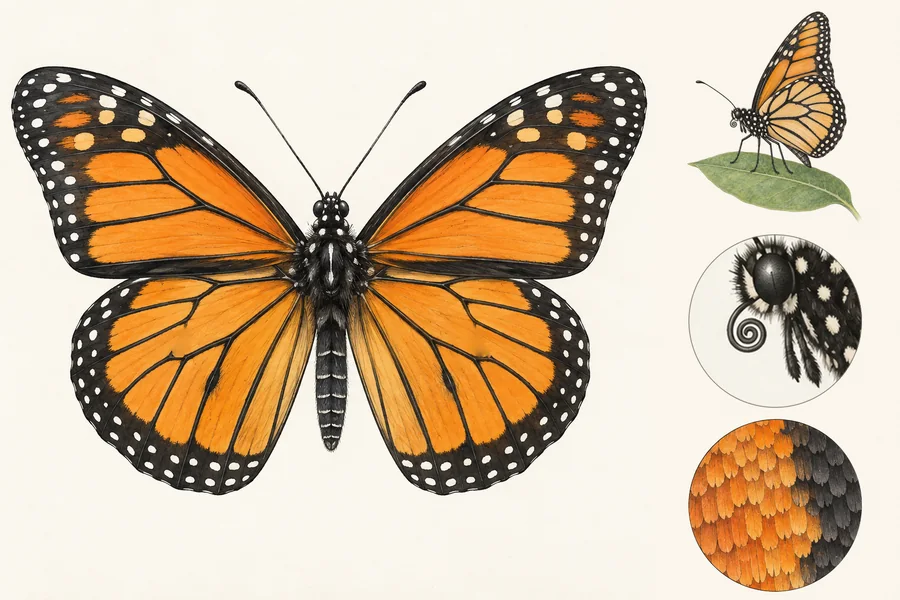
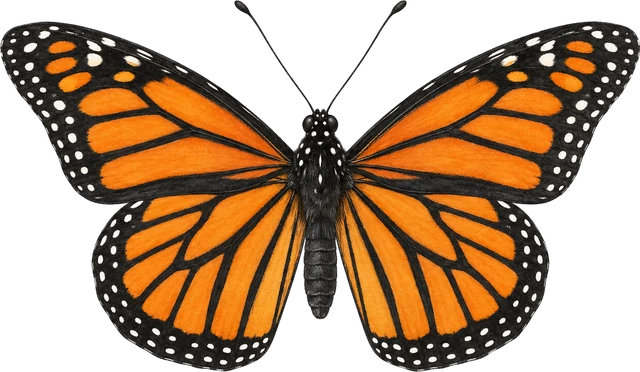
A female monarch with its wings open: thick black veins and no black spot on the hind wings.
FemaleThicker black veins, no black spot
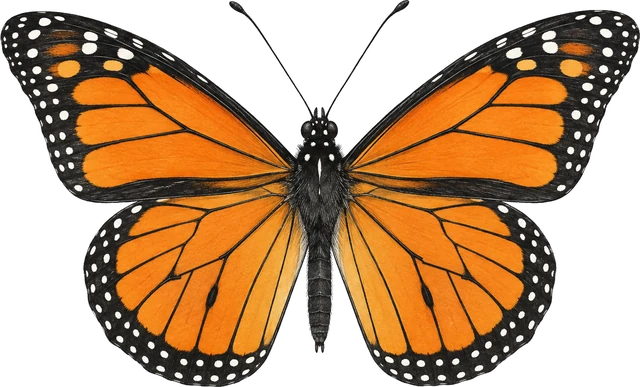
A male monarch with its wings open and one small black spot on a vein of each hind wing.
MaleA black spot on a vein of each hind wing

What to plant in an Austin yard

Monarch caterpillars eat only milkweed, and the butterflies need flowers. An Austin yard needs both. It also needs the right kinds: the milkweed most nurseries stock is the one to skip.

Milkweeds, for the eggs

Native to central Texas

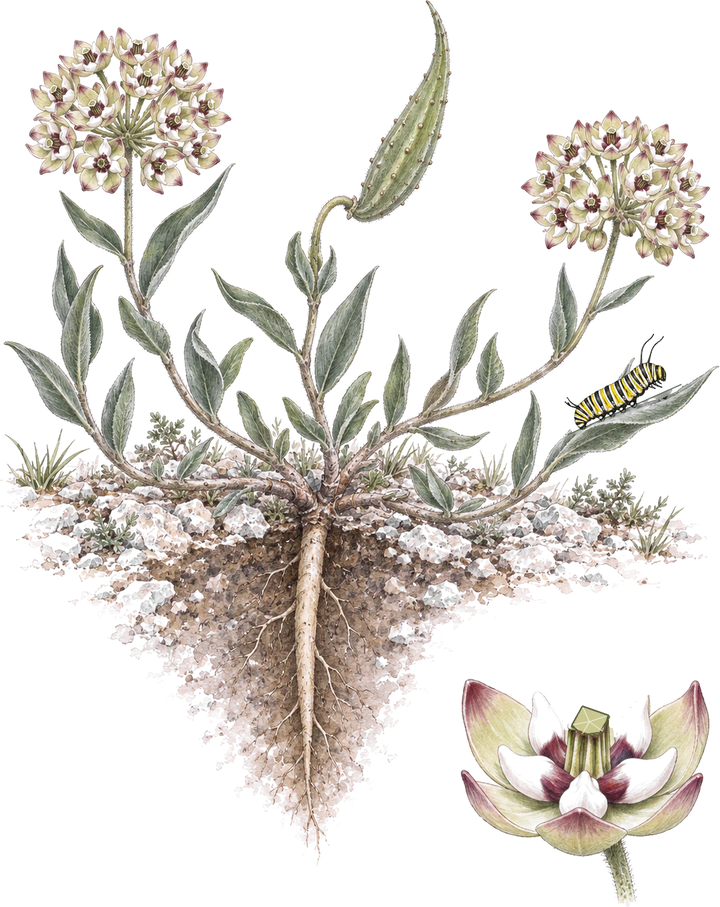
Watercolor plate of antelope horns milkweed: sprawling stems of narrow gray-green leaves from a woody crown and a long taproot in rocky soil, round balls of pale green flowers with purple tips, a curved bumpy seed pod, a caterpillar on a leaf, and a close-up of one flower with its petals cupped upward.

Antelope horns

Asclepias asperula

Host plant

Texas Parks and Wildlife describes this milkweed and green milkweed dividing the state between them. Grow both.

Full sun, dry rocky soil. TPWD, Wildflower Center

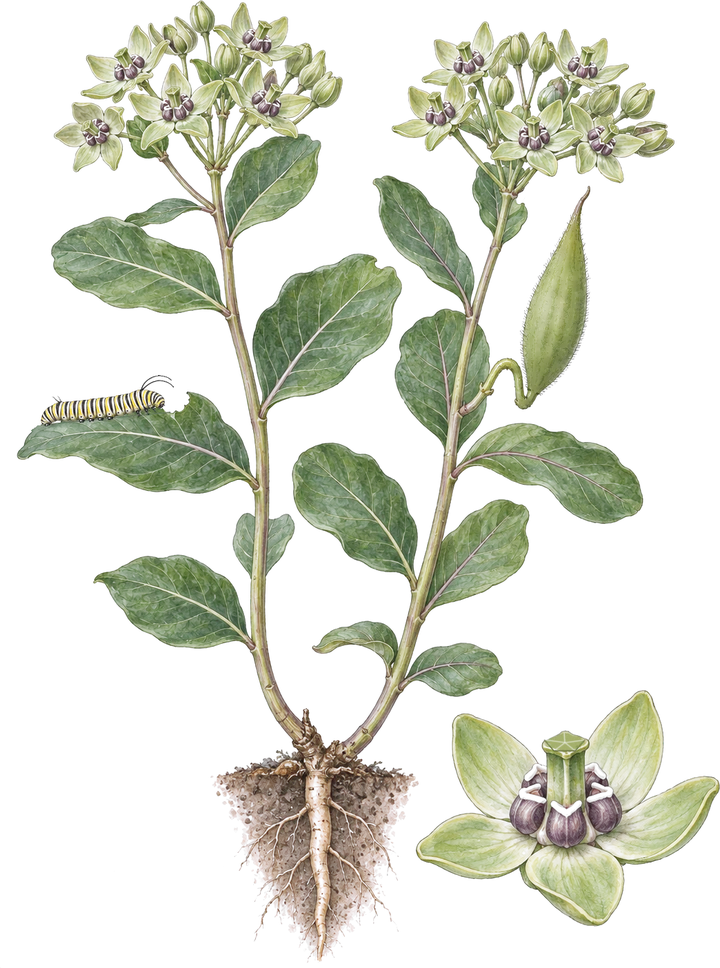
Watercolor plate of green milkweed: two upright stems with broad oval leaves, domed clusters of pale green flowers with purple centers, a smooth plump seed pod, a caterpillar on a chewed leaf, the taproot, and a close-up of one flower with five spreading green petals around purple hoods.

Green milkweed

Asclepias viridis

Host plant

The other half of the pair. The Xerces Society’s regional guide lists it plainly: “Monarch caterpillar host plant.”

Full sun, low water. Xerces, NPSOT

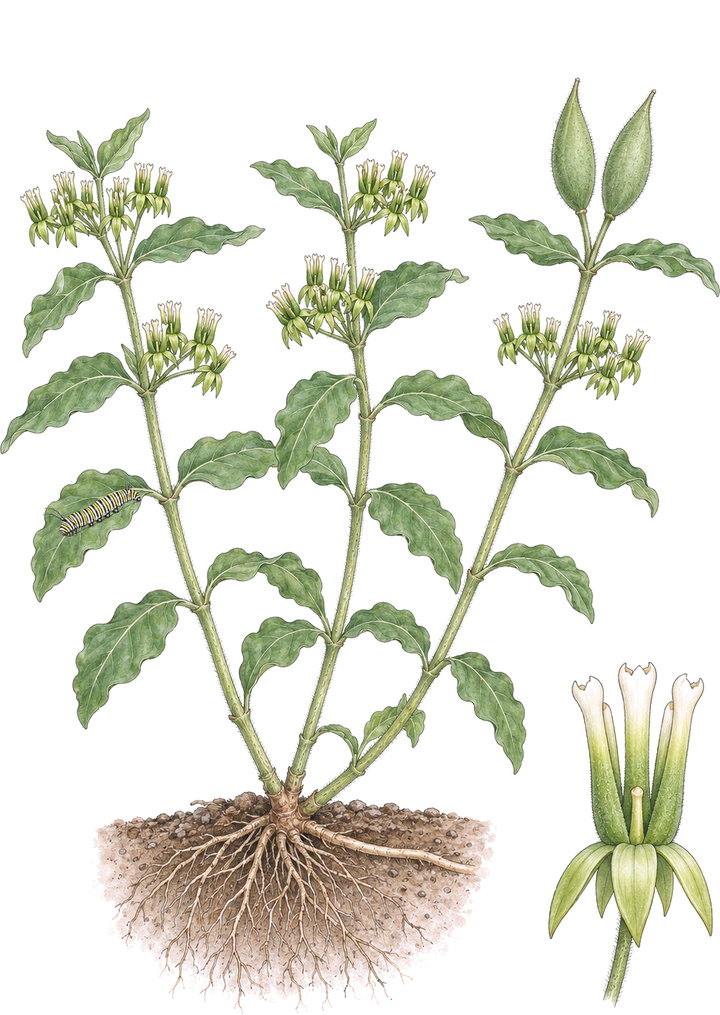
Watercolor plate of zizotes milkweed: leafy stems with wavy-edged leaves in pairs, small clusters of greenish-white flowers, a pair of smooth seed pods at the top, a caterpillar on a leaf, spreading roots, and a close-up of one flower with bent-back petals and five slender upright hoods.

Zizotes

Asclepias oenotheroides

Host plant

The one hardly anyone plants. The Wildflower Center calls it “a well-documented larval host for Monarch butterflies,” and in Texas Parks and Wildlife’s table it blooms the longest of the three.

Full sun, dry soil. Its sap irritates skin, so wash hands after. Wildflower Center, TPWD

What about butterfly weed? Asclepias tuberosa is a host plant, and pretty, but the Native Plant Society of Texas calls it “a limited monarch host plant,” and it blooms from May, after the spring monarchs have moved on. Fine for summer color; not your spring plant.

Flowers, for the butterflies

One for the spring visit, three for the fall

Watercolor plate of prairie verbena: low spreading stems with finely cut, lacy leaves, rounded heads of magenta-pink flowers, a taproot, a close-up of one five-lobed flower, and a monarch feeding on the top flower head.

Prairie verbena

Glandularia bipinnatifida

Spring nectar

Blooms from March, right when the egg-layers arrive, and it’s on the Xerces list of plants monarchs use.

Wildflower Center, Xerces

Watercolor plate of Gregg's mistflower: a clump of upright stems joined by spreading roots, deeply cut leaves in pairs, fuzzy lavender-blue flower heads, a close-up of one fuzzy head, and a monarch feeding at the top.

Gregg’s mistflower

Conoclinium greggii

Fall nectar

Xerces calls it a “magnet for monarchs and queens,” and it handles an Austin summer.

Xerces, NPSOT

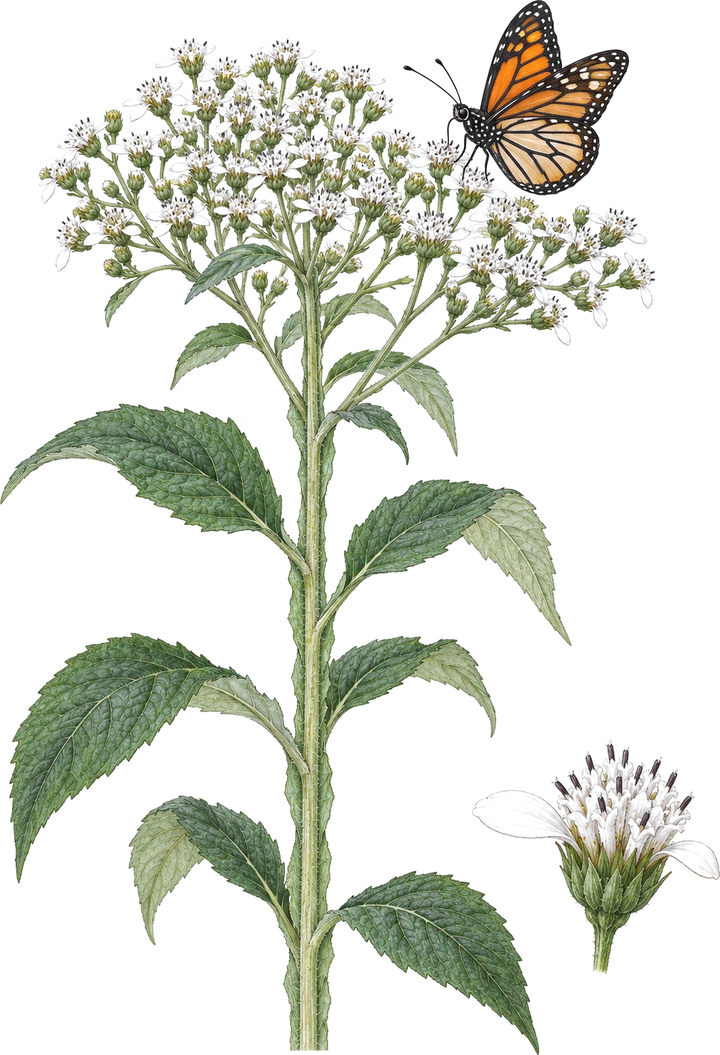
Watercolor plate of frostweed: a tall stem with narrow green wings running down it, broad toothed leaves, a wide flat-topped cluster of small white flowers, a close-up of one flower head, and a monarch feeding.

Frostweed

Verbesina virginica

Fall nectar

The answer for a shady yard. It blooms white from July into December.

Part shade to shade. Wildflower Center, Xerces

Watercolor plate of aromatic aster: a bushy, many-stemmed plant with small narrow leaves and violet daisies with yellow centers, its roots in soil, a close-up of one flower, and a monarch feeding.

Aromatic aster

Symphyotrichum oblongifolium

Fall nectar

Blooms September through November, right through the fall passage.

Sun to part shade, low water. Wildflower Center, Xerces

Plant plates are drafts awaiting a horticulturist’s review. Best milkweed for Austin, with two sources for each · Where to buy in Austin

What’s inside the guide

Nine short sections, written for Austin and illustrated throughout, plus a journal your child fills in as it happens.

  1. Where they come from

    From the winter forests of Michoacán straight to your yard, and the generations that carry on north.

  2. The map

    Where Austin sits on the monarch flyway.

  3. Your two windows

    The spring visit that brings eggs, and the fall visit that needs flowers.

  4. The plants

    Milkweeds and nectar plants for Austin, each backed by two sources.

  5. How to lay it out

    Sun, size and spacing, for whatever space you have.

  6. The Austin calendar

    What to plant each month, with the source of every date printed beside it.

  7. Egg to butterfly

    Every stage, drawn to be recognized.

  8. What goes wrong

    Tachinid flies, the OE parasite, tropical milkweed and sprayed nursery plants.

  9. A little history

    How the winter forests were found in 1975, and how families count monarchs today.

  10. Gentle Hands

    Safe handling for kids: what little hands can hold, what stays look-only, and Austin's stinging caterpillars.

  11. The observation journal

    A page for each day, for your child to fill in, and a place to count every monarch you let go.

A page from the printable journalOne for each day, from the first egg to the last one you let go

Take a closer look

The guide's plates are drawn to be pored over together: what's inside a chrysalis, why the caterpillar has two kinds of legs, how milkweed pollen hitches a ride. Six of them are free to look through.

See all six plates, with their keys

How to Get Monarchs to Breed in Your Austin Yard

$17One time.

  • Nine illustrated sections, written for Austin
  • An Austin planting calendar, with the source of every date beside it
  • Every stage from egg to butterfly, in field-guide plates
  • A printable observation journal for your child

Buying for a grandchild? It makes a lovely gift, and something to do together next spring.

Full refund within 30 days, for any reason, by email. Refund policy · A PDF, with the printable journal included.

Questions people ask first

Is it too late this year?

No. The Native Plant Society of Texas says fall is “the best time for planting milkweed seeds.” In a good year the sprouts are up by March: Journey North has a record of “9 eggs on small antelope horn milkweed sprouts” at Glen Rose, Texas, on 17 March 2025. And the fall monarchs passing through now still need flowers.

Will monarchs definitely come to my yard?

Nobody can promise that, and we won’t. What the guide gives you is the right plants, in the right place, at the right time, which is everything that’s in your control.

Do I need a big yard?

No. Monarch Watch, which certifies monarch habitats, sets no minimum size. The guide shows you how to lay out whatever space you have.

We did a butterfly kit. How is this different?

The best-selling kits raise painted lady butterflies indoors. This is about wild monarchs: you plant native milkweed, and if a monarch finds it, she lays her eggs there.

Can my kids touch the caterpillars?

Yes, gently. Monarch caterpillars don’t sting. Monarch Watch says they “can be handled safely with fingers after they are about three to four days old, but it is best to handle them as little as possible until they are over an inch long,” and never while molting. Our house rule is to let it walk onto a finger rather than pulling it off, and to leave it alone while it’s still or hanging in a J. A chrysalis is for looking only. A new butterfly needs a day before small fingers.

Two real cautions. Milkweed sap in the eyes can injure them, so wash hands with soap and water, and keep the plant out of little mouths. And the asp caterpillar, which turns up on oaks and other shade trees around Austin homes, looks soft but stings badly. The guide’s free Gentle Hands pages cover all of it, with a look, don’t touch plate and what to do if someone is stung.

Is this only for Austin?

This edition is written for Austin: its plants, its soil and its two monarch windows. Editions for other cities along the flyway are on the way.

Where our facts come from

Timing

Texas Parks and Wildlife Department; Monarch Joint Venture; Journey North; Monarch Watch; iNaturalist observations for Travis County, 2023 to 2025.

Life cycle

Monarch Joint Venture: stage lengths, sizes and days.

Plants

Lady Bird Johnson Wildflower Center; Native Plant Society of Texas; the Xerces Society; Texas A&M AgriLife Extension, Travis County.

Hometown Field Guides is not affiliated with any of these organizations. The photo-style pictures on this page are generated images, not photographs, and the illustrations are drafts awaiting expert review. The full source list · How we make an edition