The monarch, up close
Six plates from the guide, each with a key. The short lines are written to be read aloud to a child. The notes underneath are for the grown-up who wants to know how we know. Tap a number to find its part.
Plate 1
The caterpillar, outside
A full-grown caterpillar, fifth and last size, 25 to 45 mm long. The circle shows its face from the front.
Draft, awaiting expert review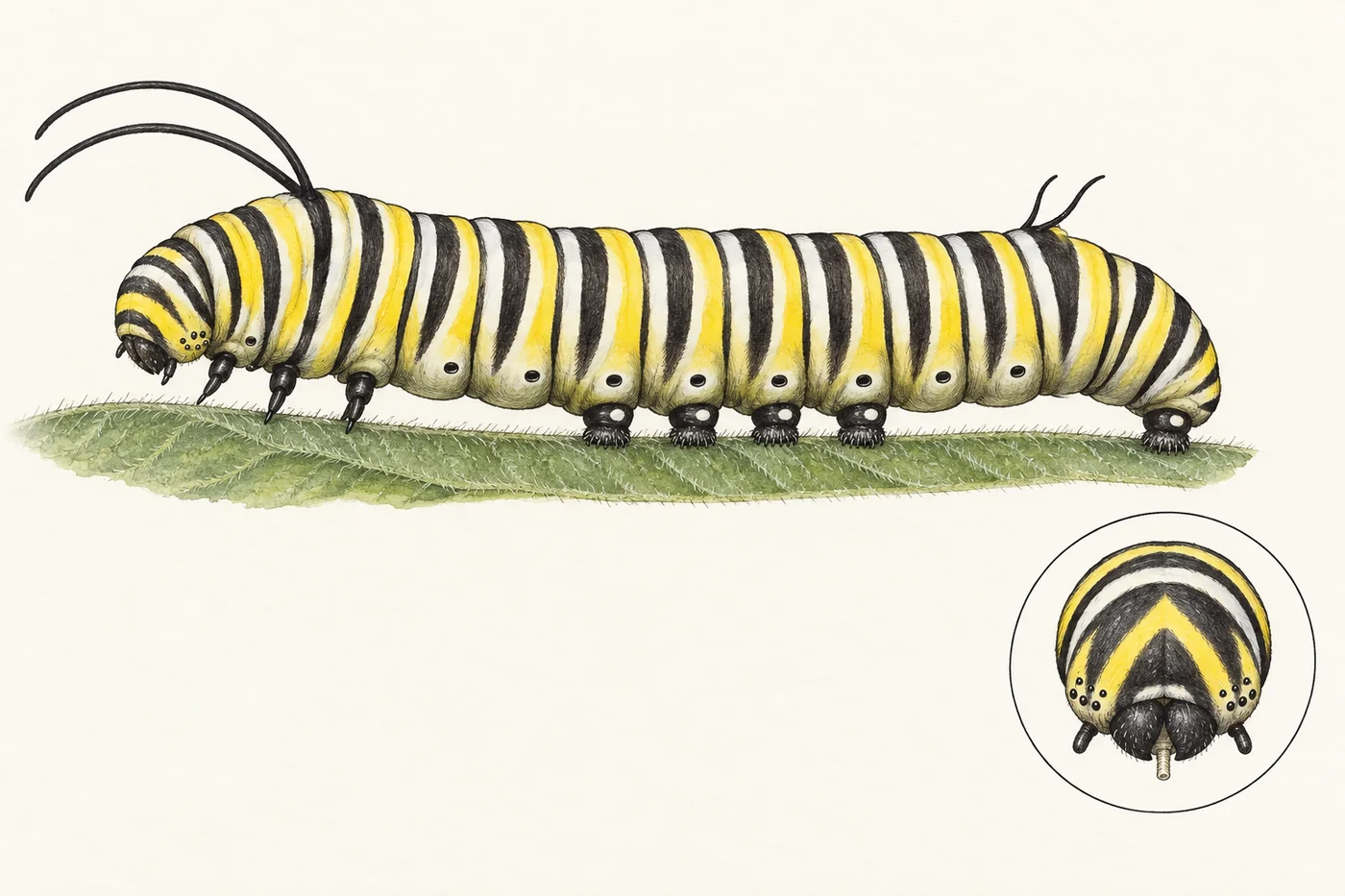
- Head capsuleA hard helmet covers the head. It can't stretch, so to grow bigger the caterpillar crawls out of it and makes a new one.
- Six simple eyesSix tiny eyes sit on each side of the head. They tell bright from dark, but a caterpillar can't see clearly.
- Front feelersThe long black whips are feelers for touch. They are not antennae, and they can't sting.
- Back feelersA shorter pair sits at the back end. They feel touch too.
- Six true legsSix jointed legs up front, like every insect has. They hold the leaf steady while the jaws chew.
- Ten soft prolegsTen soft, stumpy legs on the belly and tail. They aren't real legs, and the butterfly won't have them.
- Tiny hooksEach soft leg ends in a row of tiny hooks, like Velcro, so the caterpillar can hang on in the wind.
- Breathing holesA row of tiny holes runs along each side. The caterpillar breathes through them, not through its mouth.
- Warning stripesBold black, white and yellow stripes tell birds, "I taste bad!" The bad taste comes from milkweed.
- Jaws and spinneretStrong jaws open sideways like scissors to snip leaves. A tiny spout below the mouth pulls out silk.
- AntennaeTwo tiny stubs beside the jaws. They help the caterpillar smell its way to milkweed.
Monarch or queen?
Austin has queen butterflies too, and their caterpillars also eat milkweed. Count the feelers. A monarch has two pairs, one at each end. For a queen, the Wildflower Center says to "look for three sets of filaments, two longer pairs toward the front and a shorter pair near the rear." A monarch's bands also "generally appear similar in thickness."
Lady Bird Johnson Wildflower Center, Monarch vs. Queen.
Sources: Oberhauser & Kuda, A Field Guide to Monarch Caterpillars (University of Minnesota, 1997); USDA Forest Service, Lepidoptera of the Pacific Northwest, ch. 3; Monarch Joint Venture. Fact not pictured: two long hairs behind the head sense sound, so caterpillars can "hear" (J. Exp. Biol., 2019).
Draft, awaiting expert review. Drawn with AI assistance (ChatGPT) from a written anatomy spec and checked against it. A lepidopterist or horticulturist reviews every plate that identifies a living thing before the guide ships.
Plate 2
The caterpillar, inside
Cut away along one side, like a museum model. Everything in here is busy turning milkweed into caterpillar.
Draft, awaiting expert review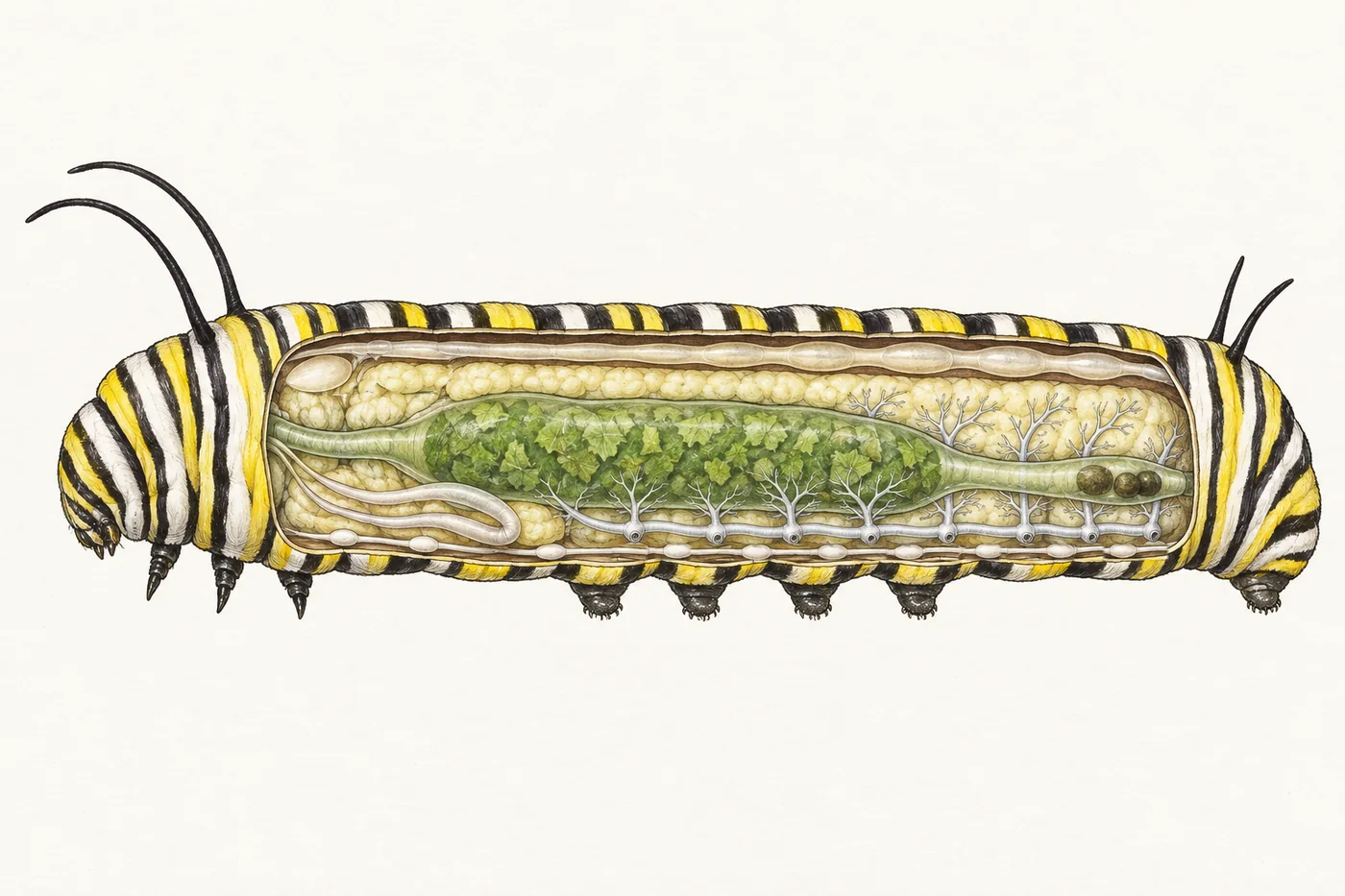
- Food pipeChewed leaf bits slide down a short food pipe from the mouth into the stomach.
- StomachThe stomach is the biggest thing inside. It fills most of the body and digests leaves almost nonstop.
- HindgutThe last part of the tube takes back water and packs the leftovers into little poop pellets called frass.
- Silk gland (one of a pair)A long tube that makes liquid silk. Its twin is on the other side. The silk becomes thread as the caterpillar pulls it out of its spinneret.
- HeartThe heart is a long tube along the back. It squeezes blood forward toward the head, and the blood seeps back.
- Belly nerve cordA nerve cord runs along the belly like a string of beads. Ours runs along our back instead.
- Fat bodyCreamy packing tissue stores food energy. It's the lunchbox for the chrysalis, which can't eat.
- Air tubesSilvery air tubes branch from the breathing holes to every part of the body, bringing air straight in.
- Wing budsTiny flat pockets of cells hide inside the caterpillar. They are the start of butterfly wings.
Also inside, not pictured
- Insect blood isn't kept in veins, and it doesn't carry air. It sloshes around the organs while the air tubes do the breathing.
- Thin "cleaning tubes" pull waste out of the blood and pass it into the gut.
- A small brain sits in the head, above the food pipe.
- Other tiny groups of starter cells wait to build the butterfly's eyes, antennae and legs.
Sources: Oberhauser & Kuda (1997); USDA Forest Service, ch. 3; NC State University, General Entomology; Monarch Joint Venture.
Draft, awaiting expert review. Drawn with AI assistance (ChatGPT) from a written anatomy spec and checked against it. A lepidopterist or horticulturist reviews every plate that identifies a living thing before the guide ships.
Plate 3
The chrysalis, outside and inside
On the right, the same chrysalis cut in half from top to bottom (a longitudinal section) in its first days and in the middle, then whole on the last day, when the wings show through the clear case. It hangs head-end down, so the butterfly's head forms at the bottom.
Draft, awaiting expert review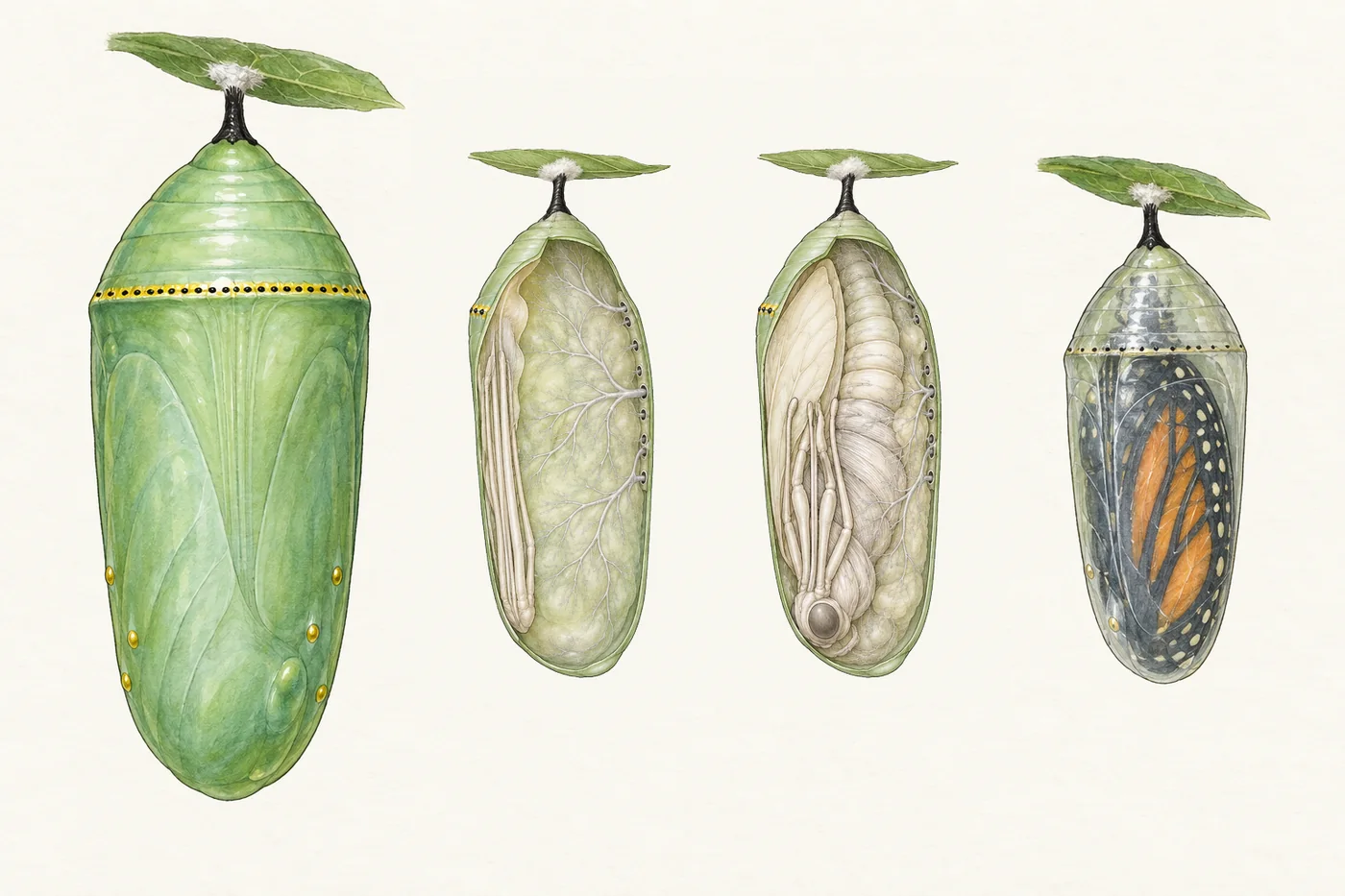
- Silk padBefore changing, the caterpillar spins a little silk mat, grabs it with its back legs and hangs upside down in a J.
- Hook stalkA black stalk at the top, covered in tiny hooks, holds on to the silk like Velcro.
- Chrysalis skinA chrysalis isn't spun or built. It's the caterpillar's own new skin, which hardens into a green case.
- Gold bandThe gold isn't real gold. Stacks of see-through layers bounce light like a soap bubble. Nobody knows for sure why it's there.
- Folded wingThis big smooth patch is a folded wing. The wings are already there, pressed flat under the skin.
- Leg, tongue and antenna casesThin ridges show where the antennae, tongue and legs lie folded, like clothes packed in a suitcase.
- Eye bumpNear the bottom, a smooth bump shows where the big butterfly eyes are forming.
- First days: breaking downInside, many caterpillar parts break down into a soft, gooey mix. But it isn't all liquid.
- Air tubes, keptThe air tubes stay. In painted lady chrysalises, X-ray scans showed them about 12 hours after the chrysalis formed.
- Middle: buildingStarter cells use that gooey food to build new parts: wings, long legs, big eyes and a two-part tongue. The two halves zip together after the butterfly comes out.
- Last day: see-throughA day before the butterfly comes out, the case turns clear. You can see the orange and black wings inside!
What happens next
- The butterfly pushes out, hangs from the empty case and pumps fluid into its crumpled wings to stretch them.
- It drips a little liquid called meconium. That isn't blood. It's waste saved up inside the chrysalis.
- Parts of the nervous system are kept and rewired. Moths can even remember a smell they learned as caterpillars.
- A chrysalis is not a cocoon. Moths spin cocoons; a butterfly's chrysalis is its own skin.
Sources: Monarch Joint Venture; Monarch Watch; Lowe et al., J. R. Soc. Interface (2013) on X-ray scans of painted lady chrysalises; Blackiston et al., PLoS ONE (2008) on memory through metamorphosis. The "it all turns to liquid" line in some popular articles is a myth.
Draft, awaiting expert review. Drawn with AI assistance (ChatGPT) from a written anatomy spec and checked against it. A lepidopterist or horticulturist reviews every plate that identifies a living thing before the guide ships.
Plate 4
The butterfly
A male, wings spread. Beside him, a monarch at rest on milkweed, a close-up of its head, and a close-up of the wing.
Draft, awaiting expert review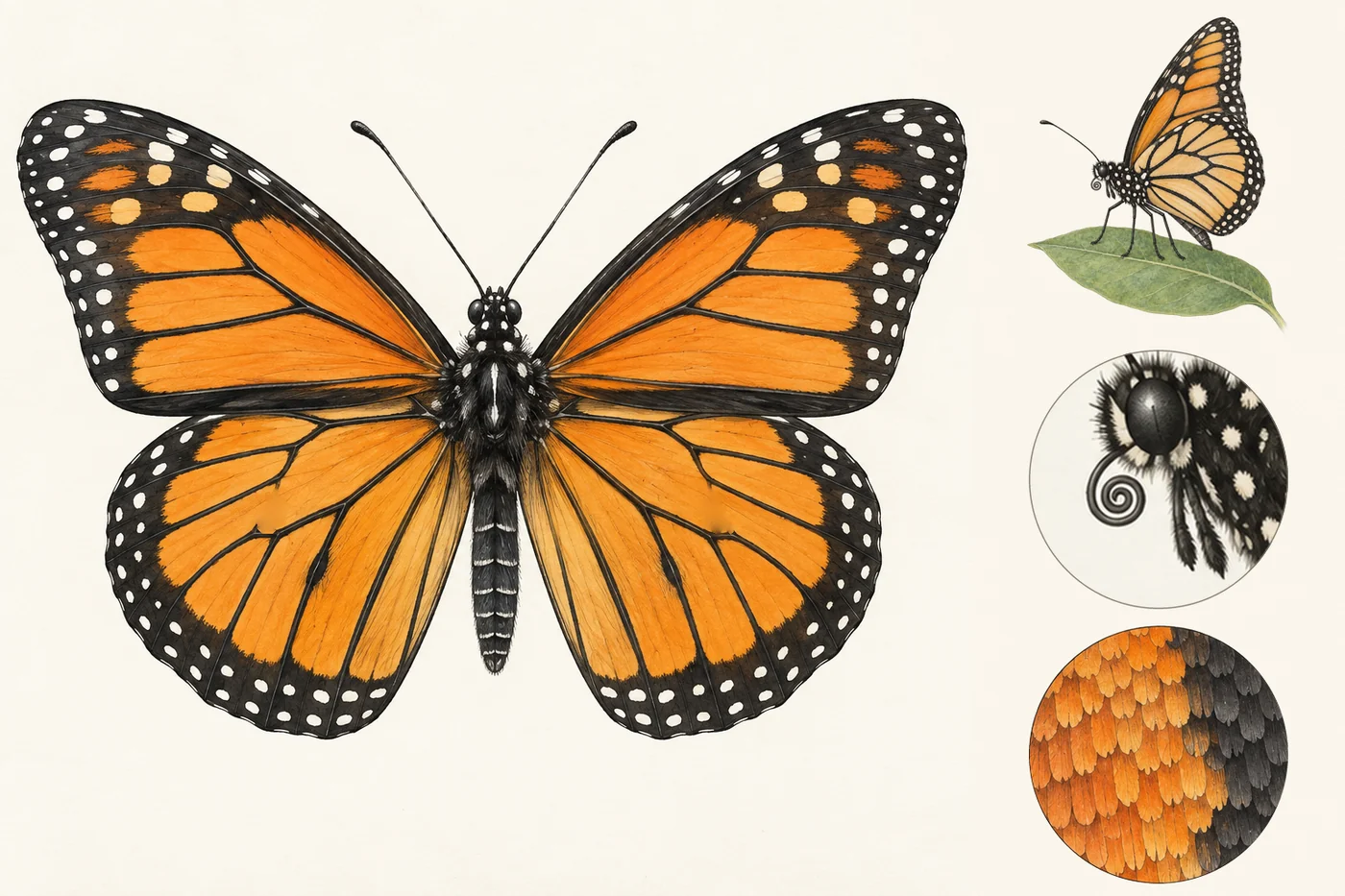
- Compound eyesEach big eye is made of thousands of tiny eyes working together. Butterflies can even sense which way light waves are traveling, something we can't see.
- Clubbed antennaeThe knobbed feelers smell flowers and mates. They also hold tiny clocks that help migrating monarchs steer by the sun.
- Curly tongueThe tongue is a long drinking straw, rolled up like a party blower. It uncurls to sip nectar.
- PalpsTwo furry pads beside the face cover the rolled-up tongue and help sense the world.
- ThoraxThe middle part is the engine room, packed with muscles that work the wings and legs.
- Four wingsA butterfly has four wings, not two. The front pair is bigger and pointier; the back pair is rounder.
- Wing overlapThe front wing rests on a flap of the back wing. No hooks: they overlap and flap together as one.
- Tiny front legsMonarchs have six legs, but the front two are tiny and tucked up, so they look like they have four.
- Tasting feetMonarchs taste with their feet! A mother taps a leaf to check it's milkweed before she lays an egg.
- ScalesThe colors come from tiny scales laid like roof shingles. "Lepidoptera" means "scale wings".
- VeinsThe black lines are veins, tubes that stiffen the wing. A new butterfly pumps fluid through them to open its wings.
- Male scent spotBoys have a black spot on each back wing, right on a vein. It's made of special scent scales.
- AbdomenThe long back section holds the stomach, and in mothers, the eggs.
- ClaspersBoys have two little claspers at the tip of the tail, for holding on when they pair up.
- Orange-and-black warningBright orange and black say "Don't eat me!" Monarchs keep milkweed poison in their bodies, so a bird that tries one gets a nasty taste. A few birds eat them anyway.
Sources: Monarch Joint Venture; Monarch Watch, Sexing Monarchs; Merlin, Gegear & Reppert, Science (2009) and Guerra et al., Nat. Commun. (2012) on the antenna clock. Not pictured: a new butterfly's tongue comes out in two halves, which it zips together soon after emerging.
Draft, awaiting expert review. Drawn with AI assistance (ChatGPT) from a written anatomy spec and checked against it. A lepidopterist or horticulturist reviews every plate that identifies a living thing before the guide ships.
Plate 5
Antelope horns milkweed
Asclepias asperula, an important spring host for monarchs in the southern United States (and one of the toughest for caterpillars to eat), with close-ups of the flower, its pollen clip, the pod and the sap.
Draft, awaiting expert review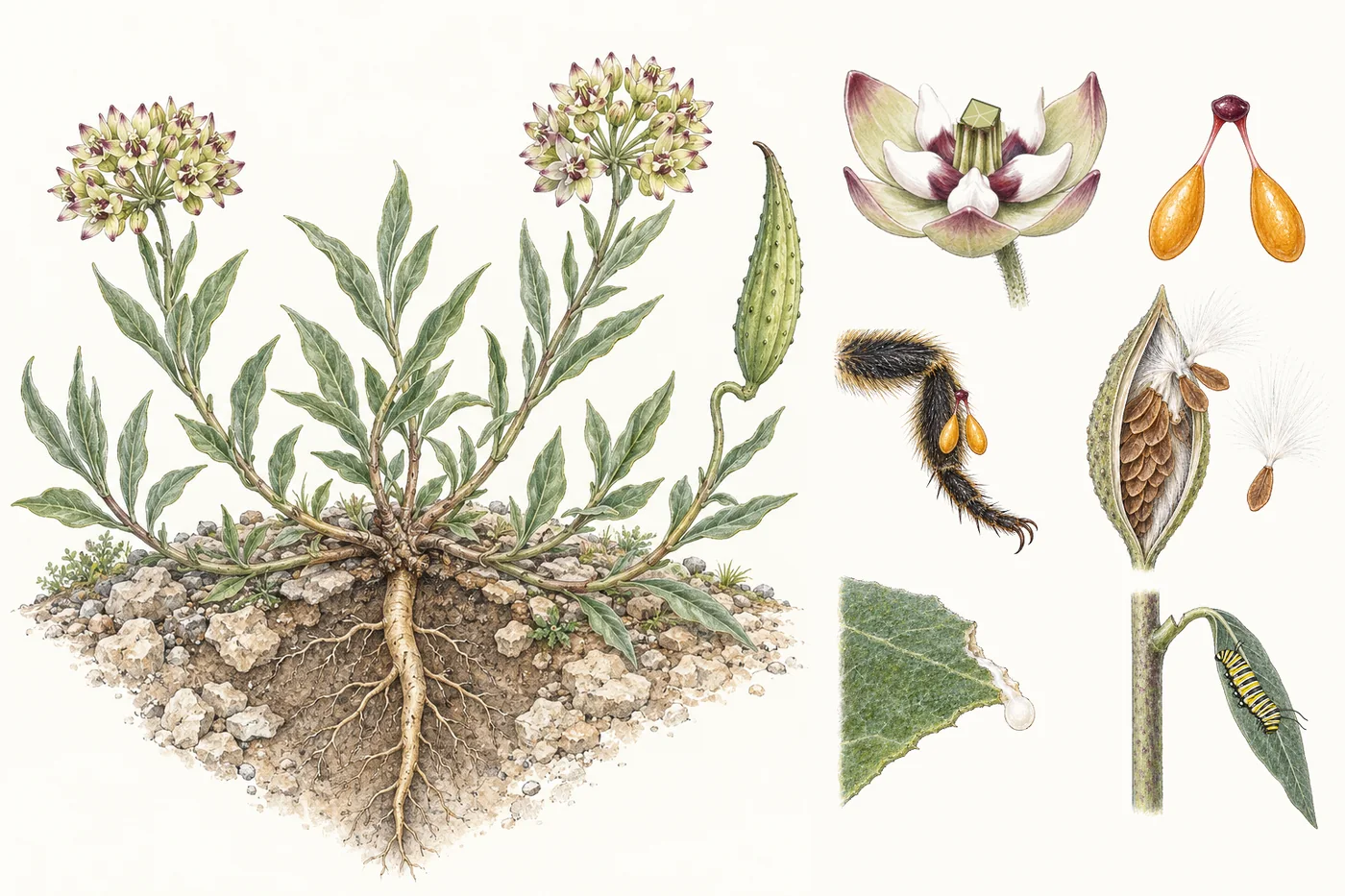
- Flower ballLots of little flowers grow from one point, like the spokes of an umbrella. The round cluster is called an umbel.
- Petals cup upwardOn most milkweeds the petals fold back. On antelope horns they cup upward around the middle, like a little bowl.
- HoodsFive scoop-shaped hoods hold sweet nectar. Bees and wasps clamber over them to drink.
- Center columnThe flower's middle is one joined-up column, where the pollen parts and the seed-making parts are fused.
- Pollen clipMilkweed pollen isn't dust. It comes in two waxy bags hanging from a tiny clip, like saddlebags.
- The clipThe tiny dark knob joining the two bags is the clip. It grabs an insect's foot as the insect pulls its leg out of a slit in the flower. The flower close-up doesn't show the slits.
- Pollen bagsEach waxy bag is packed with pollen. Slipped into another flower, it starts the seeds.
- Along for the rideThe clip hitches a ride on a bee's leg. Its arms twist as they dry, so the pollen only fits the next flower.
- Seed podThe curved green pod looks like an antelope's horn. That's where the name comes from!
- SeedsInside, flat brown seeds are packed tight, overlapping like fish scales.
- Silk parachuteEach seed wears a silky parachute. When the pod splits, the wind carries the seeds far away.
- Milky sapBreak a leaf and white, sticky sap oozes out. It's poisonous, and it can glue a tiny caterpillar's jaws shut.
- Caterpillar notchBig caterpillars bite a notch in the leaf stalk first. That drains the sap away, so the leaf is safer to eat.
- TaprootA thick root reaches deep underground. It helps the plant survive dry summers and grow new stems.
No horns here
Most milkweeds have a tiny curved horn inside each hood. Antelope horns doesn't. The "horns" in its name are the curved seed pods. Even a Texas Parks and Wildlife magazine article called the flower's star a ring of "horns."
Sources: Lady Bird Johnson Wildflower Center; Monarch Watch milkweed profiles; Native Plant Society of Texas; Hastings et al., PeerJ (2026) on latex and toxins; Dussourd & Eisner, Science (1987) on leaf-notching; MacIvor et al., Ecol. Evol. (2017) on which insects carry the pollen.
Draft, awaiting expert review. Drawn with AI assistance (ChatGPT) from a written anatomy spec and checked against it. A lepidopterist or horticulturist reviews every plate that identifies a living thing before the guide ships.
Plate 6 · Gentle Hands
Look, don't touch
Only one of these four is safe to hold. The other three sting. The asp, perhaps the most common stinging caterpillar in Texas, turns up on oaks, pecans, elms, hackberries and dwarf yaupon; none of our sources lists milkweed. It looks soft enough to pet.
Draft, awaiting expert review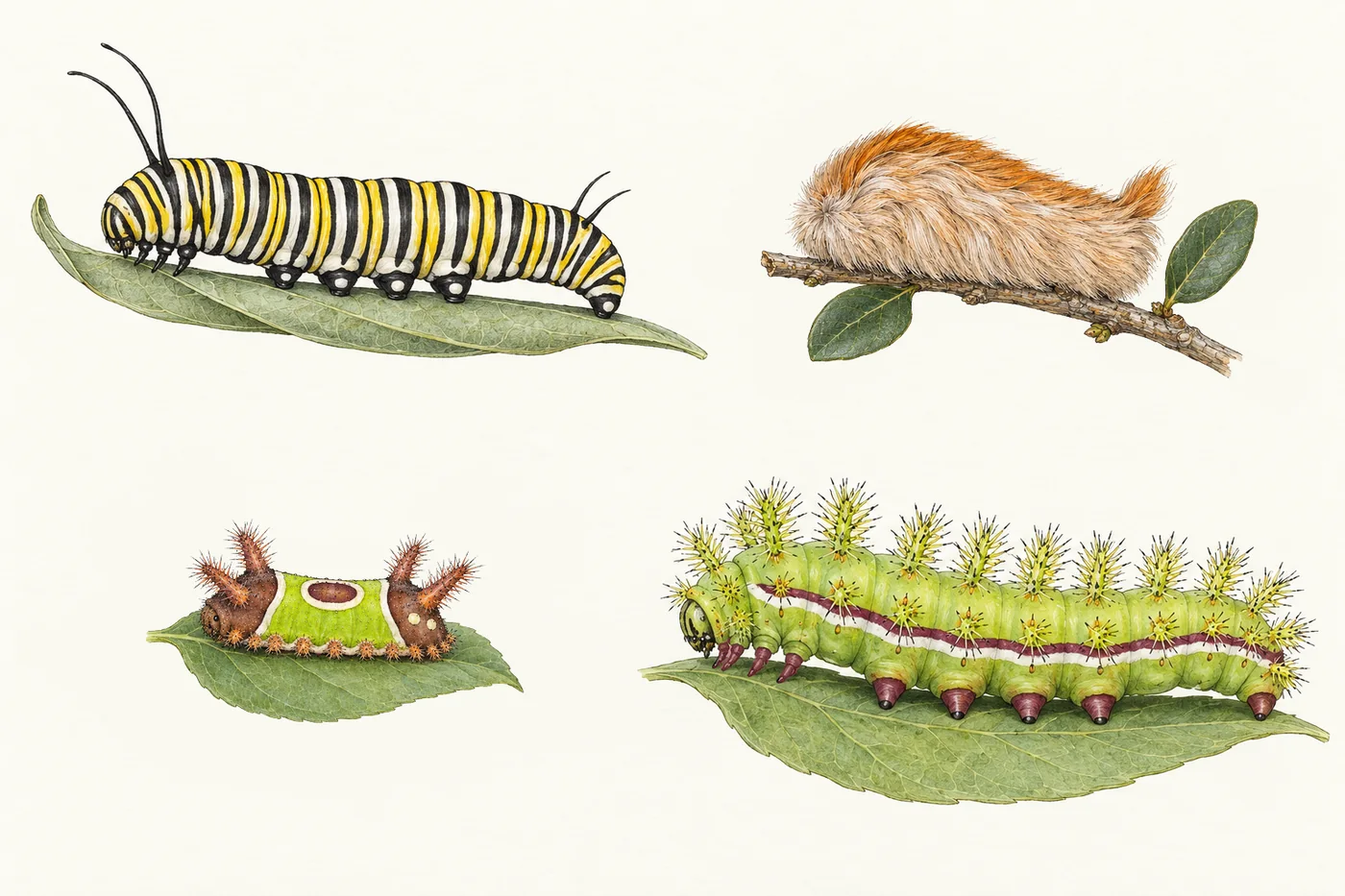
- Monarch: safe to hold, gently and brieflyEven black, white and yellow bands and two pairs of soft black feelers. Fine touch hairs, but no stinging spines. Found on milkweed. After it's a few days old, hold it as little as possible until it's over an inch long, and leave it alone when it's still, molting or hanging in a J.
- Asp (southern flannel moth): never touchA furry teardrop; Texas A&M says they "resemble a tuft of cotton or fur." Hidden spines give intense, throbbing pain within minutes. Texas poison-center stings peak in July and in October and November.
- Saddleback: never touchA brown body with a bright green "saddle blanket" and an oval purplish-brown spot in the middle. Spiny horns at both ends sting.
- Io moth: never touchPale green, with a maroon stripe edged in white along each side, and clusters of branched spines that sting.
Smooth and stripy on milkweed: yes. Fuzzy or spiky: no. Get a grown-up.
If someone is stung, or gets sap in an eye
- Stung: brush the caterpillar off with a stick or tool, not bare hands. Press tape on the spot, sticky side down, pull it off, and repeat with fresh tape. Wash with soap and water, then use an ice pack. Ask Poison Help or your pediatrician before giving an antihistamine.
- Get care right away for a sting near an eye, hives spreading over the body, or severe pain. Call 911 for trouble breathing, swelling of the face or lips, or fainting.
- Milkweed sap in an eye: don't rub, and take out any contact lens. Rinse with room-temperature water for 10 to 15 minutes and call Poison Help. If pain, blurry vision, light sensitivity or redness starts, even hours later, get an eye exam that day and tell the doctor "milkweed sap."
- Poison Help: 1-800-222-1222. It's free, open 24 hours, and reaches the Texas Poison Center Network.
Sources: Texas A&M AgriLife Extension (ENT-3010 and 2025 guidance); poison.org; Lu et al., J. Emerg. Med. (2026) on delayed eye symptoms; Forrester, Texas Department of State Health Services, Wilderness & Environmental Medicine (2018): 3,484 asp stings reported to Texas poison centers from 2000 to 2016, 59% in October and November, 91% at home. Don't spray Bt for asps near milkweed: Texas A&M notes it also kills the non-stinging caterpillars. First aid is general guidance; a medical reviewer checks this page before it publishes.
Draft, awaiting expert review. Drawn with AI assistance (ChatGPT) from a written anatomy spec and checked against it. A lepidopterist or horticulturist reviews every plate that identifies a living thing before the guide ships.
Also free: Plate I, the whole life cycle on one plant. These are draft plates for the Hometown Field Guides monarch editions. The drawings were made with ChatGPT from written anatomy specs, and each was checked against its spec. Every plate that identifies a living thing is reviewed by a lepidopterist or horticulturist before it ships.