Plate 5
Antelope horns milkweed
Asclepias asperula, an important spring host for monarchs in the southern United States (and one of the toughest for caterpillars to eat), with close-ups of the flower, its pollen clip, the pod and the sap.
Draft, awaiting expert review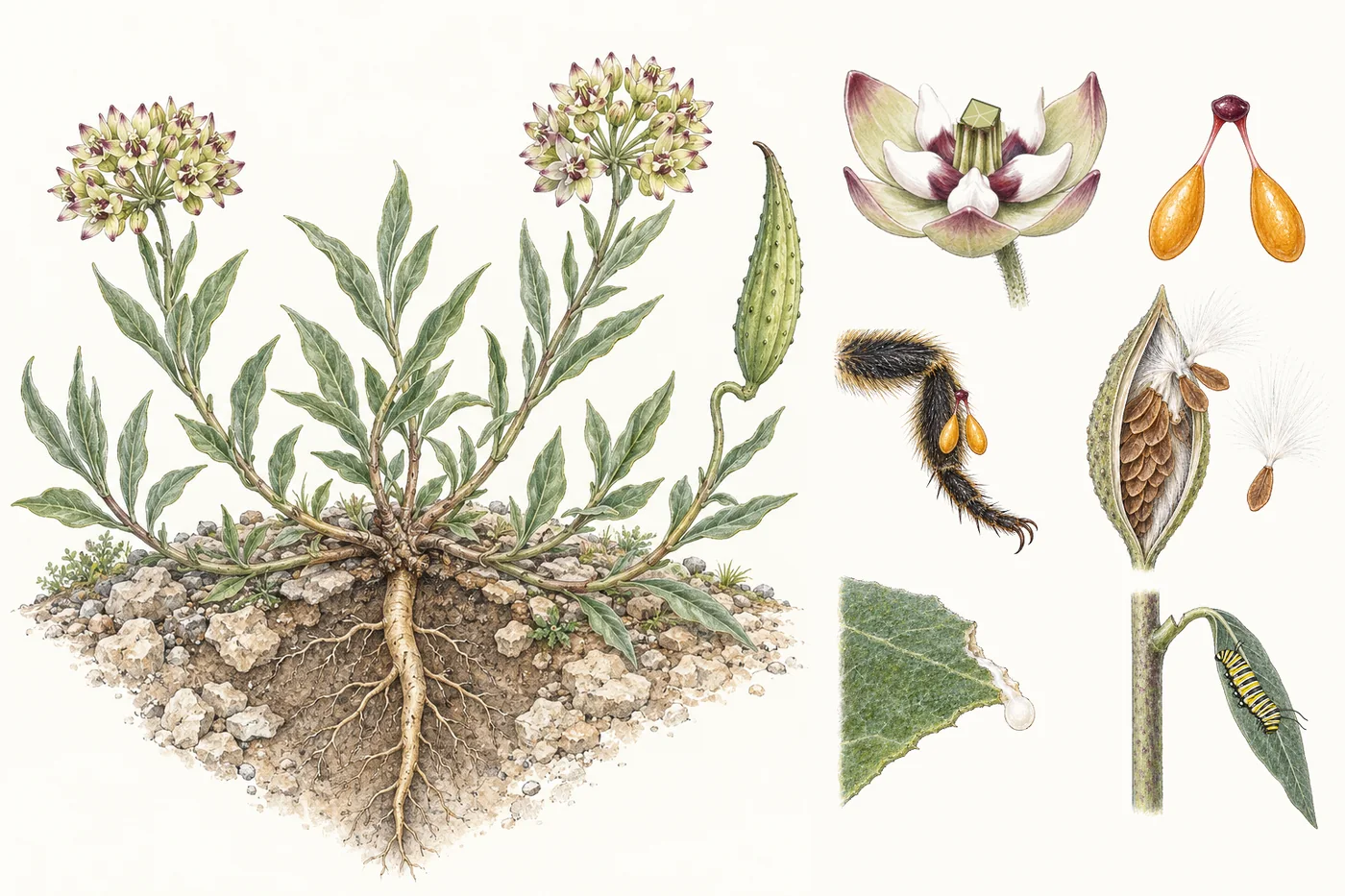
- Flower ballLots of little flowers grow from one point, like the spokes of an umbrella. The round cluster is called an umbel.
- Petals cup upwardOn most milkweeds the petals fold back. On antelope horns they cup upward around the middle, like a little bowl.
- HoodsFive scoop-shaped hoods hold sweet nectar. Bees and wasps clamber over them to drink.
- Center columnThe flower's middle is one joined-up column, where the pollen parts and the seed-making parts are fused.
- Pollen clipMilkweed pollen isn't dust. It comes in two waxy bags hanging from a tiny clip, like saddlebags.
- The clipThe tiny dark knob joining the two bags is the clip. It grabs an insect's foot as the insect pulls its leg out of a slit in the flower. The flower close-up doesn't show the slits.
- Pollen bagsEach waxy bag is packed with pollen. Slipped into another flower, it starts the seeds.
- Along for the rideThe clip hitches a ride on a bee's leg. Its arms twist as they dry, so the pollen only fits the next flower.
- Seed podThe curved green pod looks like an antelope's horn. That's where the name comes from!
- SeedsInside, flat brown seeds are packed tight, overlapping like fish scales.
- Silk parachuteEach seed wears a silky parachute. When the pod splits, the wind carries the seeds far away.
- Milky sapBreak a leaf and white, sticky sap oozes out. It's poisonous, and it can glue a tiny caterpillar's jaws shut.
- Caterpillar notchBig caterpillars bite a notch in the leaf stalk first. That drains the sap away, so the leaf is safer to eat.
- TaprootA thick root reaches deep underground. It helps the plant survive dry summers and grow new stems.
No horns here
Most milkweeds have a tiny curved horn inside each hood. Antelope horns doesn't. The "horns" in its name are the curved seed pods. Even a Texas Parks and Wildlife magazine article called the flower's star a ring of "horns."
Sources: Lady Bird Johnson Wildflower Center; Monarch Watch milkweed profiles; Native Plant Society of Texas; Hastings et al., PeerJ (2026) on latex and toxins; Dussourd & Eisner, Science (1987) on leaf-notching; MacIvor et al., Ecol. Evol. (2017) on which insects carry the pollen.
Draft, awaiting expert review. Drawn with AI assistance (ChatGPT) from a written anatomy spec and checked against it. A lepidopterist or horticulturist reviews every plate that identifies a living thing before the guide ships.