Plate 4
The butterfly
A male, wings spread. Beside him, a monarch at rest on milkweed, a close-up of its head, and a close-up of the wing.
Draft, awaiting expert review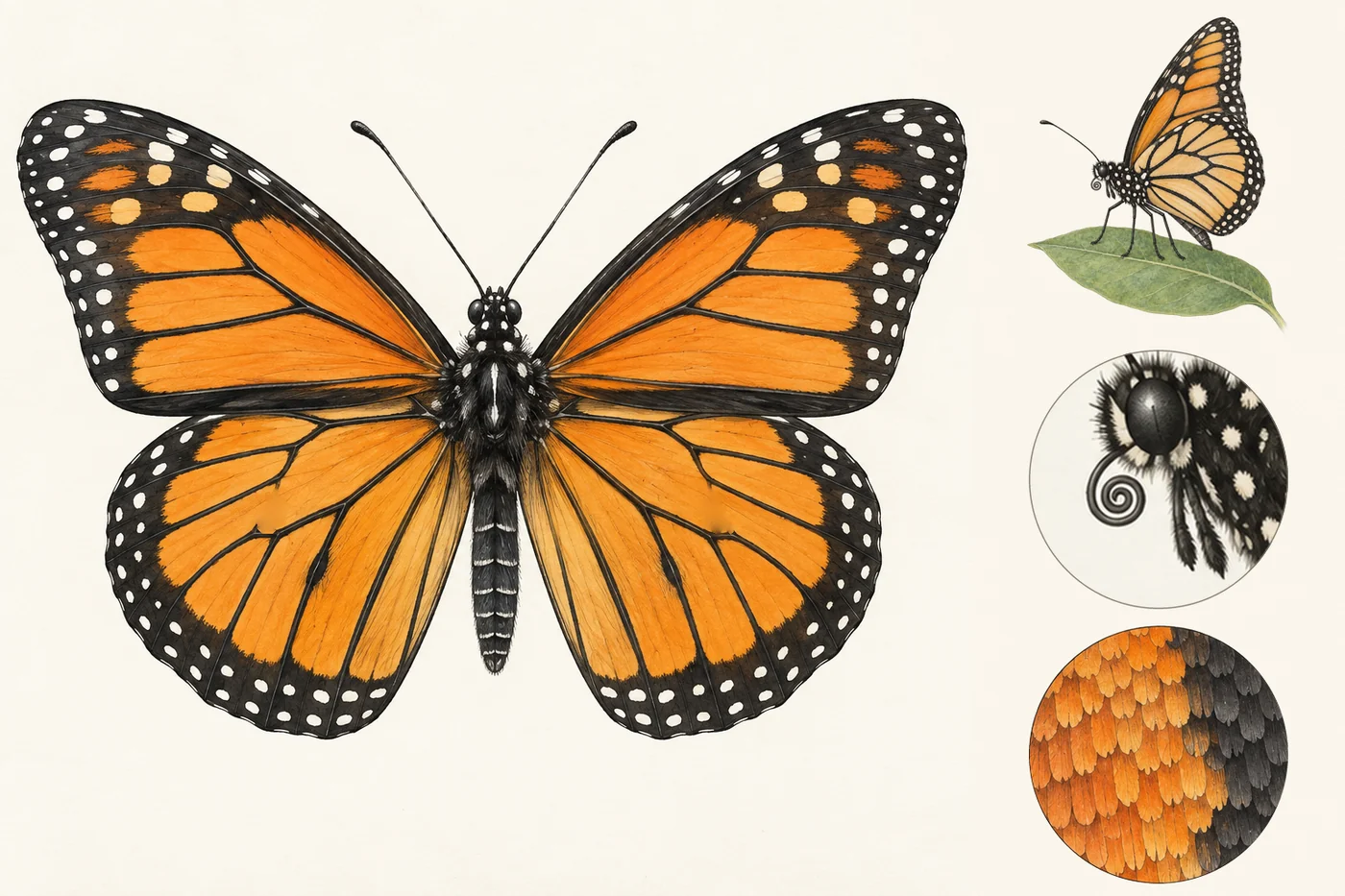
- Compound eyesEach big eye is made of thousands of tiny eyes working together. Butterflies can even sense which way light waves are traveling, something we can't see.
- Clubbed antennaeThe knobbed feelers smell flowers and mates. They also hold tiny clocks that help migrating monarchs steer by the sun.
- Curly tongueThe tongue is a long drinking straw, rolled up like a party blower. It uncurls to sip nectar.
- PalpsTwo furry pads beside the face cover the rolled-up tongue and help sense the world.
- ThoraxThe middle part is the engine room, packed with muscles that work the wings and legs.
- Four wingsA butterfly has four wings, not two. The front pair is bigger and pointier; the back pair is rounder.
- Wing overlapThe front wing rests on a flap of the back wing. No hooks: they overlap and flap together as one.
- Tiny front legsMonarchs have six legs, but the front two are tiny and tucked up, so they look like they have four.
- Tasting feetMonarchs taste with their feet! A mother taps a leaf to check it's milkweed before she lays an egg.
- ScalesThe colors come from tiny scales laid like roof shingles. "Lepidoptera" means "scale wings".
- VeinsThe black lines are veins, tubes that stiffen the wing. A new butterfly pumps fluid through them to open its wings.
- Male scent spotBoys have a black spot on each back wing, right on a vein. It's made of special scent scales.
- AbdomenThe long back section holds the stomach, and in mothers, the eggs.
- ClaspersBoys have two little claspers at the tip of the tail, for holding on when they pair up.
- Orange-and-black warningBright orange and black say "Don't eat me!" Monarchs keep milkweed poison in their bodies, so a bird that tries one gets a nasty taste. A few birds eat them anyway.
Sources: Monarch Joint Venture; Monarch Watch, Sexing Monarchs; Merlin, Gegear & Reppert, Science (2009) and Guerra et al., Nat. Commun. (2012) on the antenna clock. Not pictured: a new butterfly's tongue comes out in two halves, which it zips together soon after emerging.
Draft, awaiting expert review. Drawn with AI assistance (ChatGPT) from a written anatomy spec and checked against it. A lepidopterist or horticulturist reviews every plate that identifies a living thing before the guide ships.