Plate 1
The caterpillar, outside
A full-grown caterpillar, fifth and last size, 25 to 45 mm long. The circle shows its face from the front.
Draft, awaiting expert review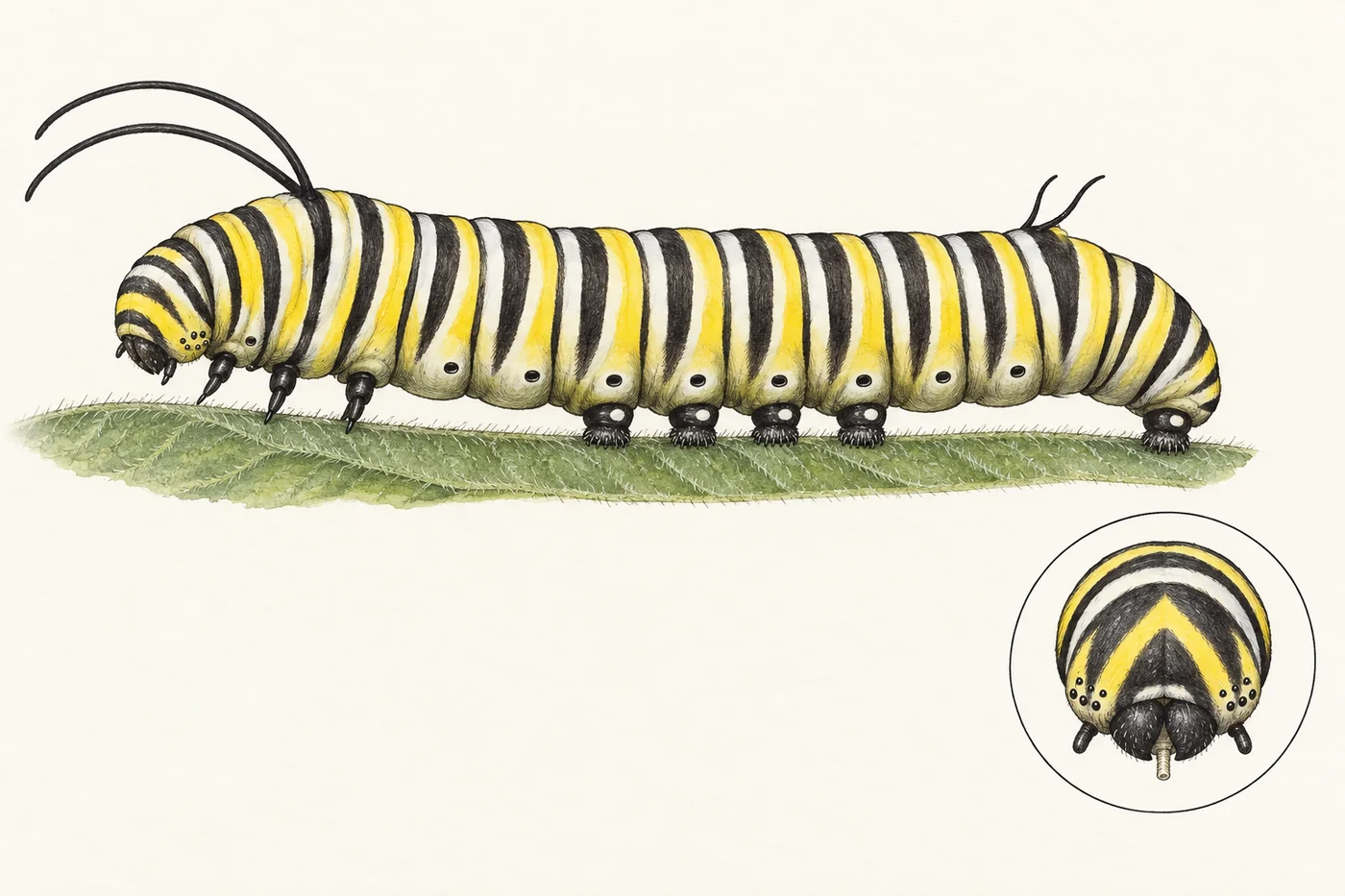
- Head capsuleA hard helmet covers the head. It can't stretch, so to grow bigger the caterpillar crawls out of it and makes a new one.
- Six simple eyesSix tiny eyes sit on each side of the head. They tell bright from dark, but a caterpillar can't see clearly.
- Front feelersThe long black whips are feelers for touch. They are not antennae, and they can't sting.
- Back feelersA shorter pair sits at the back end. They feel touch too.
- Six true legsSix jointed legs up front, like every insect has. They hold the leaf steady while the jaws chew.
- Ten soft prolegsTen soft, stumpy legs on the belly and tail. They aren't real legs, and the butterfly won't have them.
- Tiny hooksEach soft leg ends in a row of tiny hooks, like Velcro, so the caterpillar can hang on in the wind.
- Breathing holesA row of tiny holes runs along each side. The caterpillar breathes through them, not through its mouth.
- Warning stripesBold black, white and yellow stripes tell birds, "I taste bad!" The bad taste comes from milkweed.
- Jaws and spinneretStrong jaws open sideways like scissors to snip leaves. A tiny spout below the mouth pulls out silk.
- AntennaeTwo tiny stubs beside the jaws. They help the caterpillar smell its way to milkweed.
Monarch or queen?
Austin has queen butterflies too, and their caterpillars also eat milkweed. Count the feelers. A monarch has two pairs, one at each end. For a queen, the Wildflower Center says to "look for three sets of filaments, two longer pairs toward the front and a shorter pair near the rear." A monarch's bands also "generally appear similar in thickness."
Lady Bird Johnson Wildflower Center, Monarch vs. Queen.
Sources: Oberhauser & Kuda, A Field Guide to Monarch Caterpillars (University of Minnesota, 1997); USDA Forest Service, Lepidoptera of the Pacific Northwest, ch. 3; Monarch Joint Venture. Fact not pictured: two long hairs behind the head sense sound, so caterpillars can "hear" (J. Exp. Biol., 2019).
Draft, awaiting expert review. Drawn with AI assistance (ChatGPT) from a written anatomy spec and checked against it. A lepidopterist or horticulturist reviews every plate that identifies a living thing before the guide ships.