Plate 3
The chrysalis, outside and inside
On the right, the same chrysalis cut in half from top to bottom (a longitudinal section) in its first days and in the middle, then whole on the last day, when the wings show through the clear case. It hangs head-end down, so the butterfly's head forms at the bottom.
Draft, awaiting expert review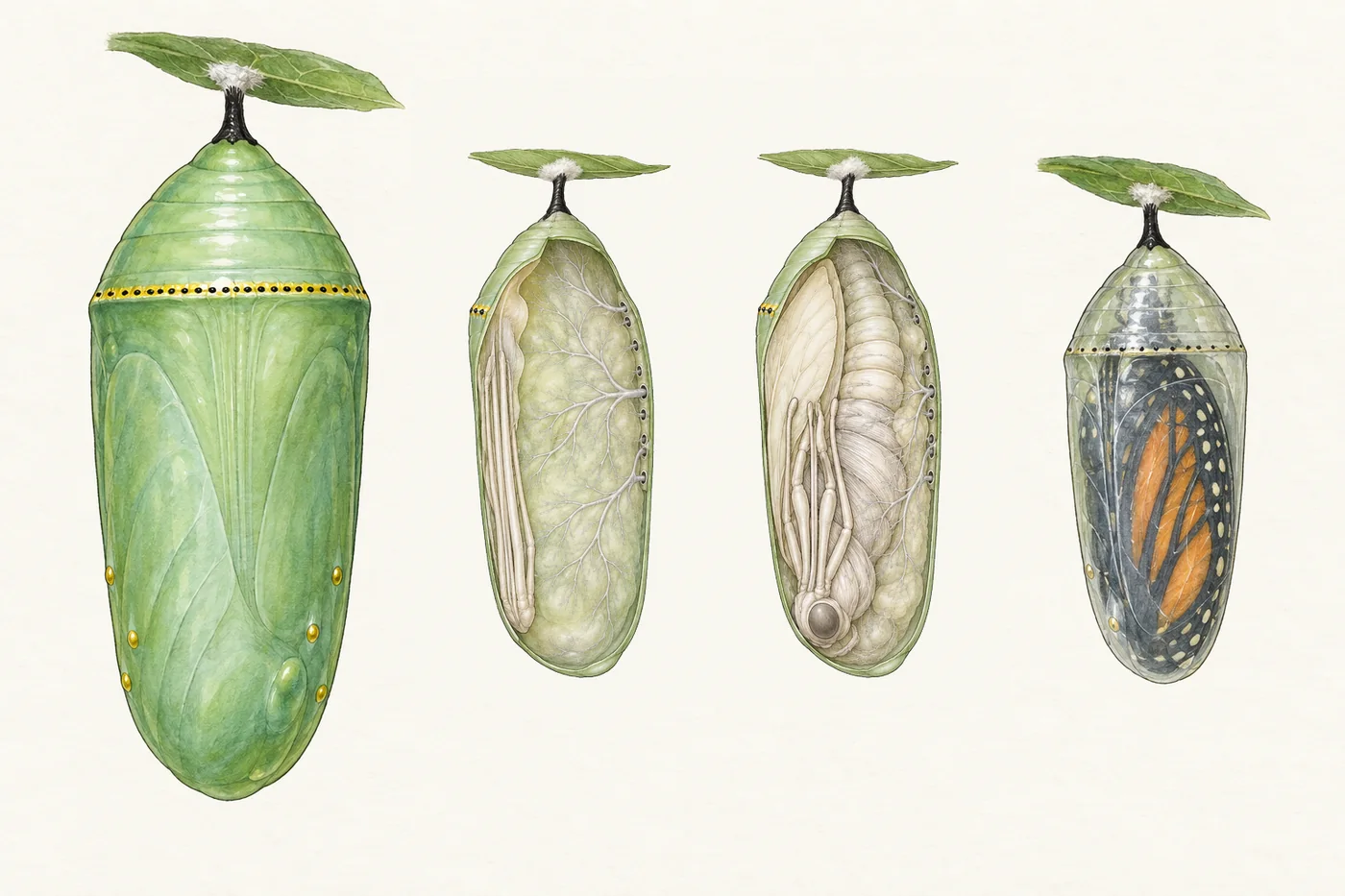
- Silk padBefore changing, the caterpillar spins a little silk mat, grabs it with its back legs and hangs upside down in a J.
- Hook stalkA black stalk at the top, covered in tiny hooks, holds on to the silk like Velcro.
- Chrysalis skinA chrysalis isn't spun or built. It's the caterpillar's own new skin, which hardens into a green case.
- Gold bandThe gold isn't real gold. Stacks of see-through layers bounce light like a soap bubble. Nobody knows for sure why it's there.
- Folded wingThis big smooth patch is a folded wing. The wings are already there, pressed flat under the skin.
- Leg, tongue and antenna casesThin ridges show where the antennae, tongue and legs lie folded, like clothes packed in a suitcase.
- Eye bumpNear the bottom, a smooth bump shows where the big butterfly eyes are forming.
- First days: breaking downInside, many caterpillar parts break down into a soft, gooey mix. But it isn't all liquid.
- Air tubes, keptThe air tubes stay. In painted lady chrysalises, X-ray scans showed them about 12 hours after the chrysalis formed.
- Middle: buildingStarter cells use that gooey food to build new parts: wings, long legs, big eyes and a two-part tongue. The two halves zip together after the butterfly comes out.
- Last day: see-throughA day before the butterfly comes out, the case turns clear. You can see the orange and black wings inside!
What happens next
- The butterfly pushes out, hangs from the empty case and pumps fluid into its crumpled wings to stretch them.
- It drips a little liquid called meconium. That isn't blood. It's waste saved up inside the chrysalis.
- Parts of the nervous system are kept and rewired. Moths can even remember a smell they learned as caterpillars.
- A chrysalis is not a cocoon. Moths spin cocoons; a butterfly's chrysalis is its own skin.
Sources: Monarch Joint Venture; Monarch Watch; Lowe et al., J. R. Soc. Interface (2013) on X-ray scans of painted lady chrysalises; Blackiston et al., PLoS ONE (2008) on memory through metamorphosis. The "it all turns to liquid" line in some popular articles is a myth.
Draft, awaiting expert review. Drawn with AI assistance (ChatGPT) from a written anatomy spec and checked against it. A lepidopterist or horticulturist reviews every plate that identifies a living thing before the guide ships.