Plate 6 · Gentle Hands
Look, don't touch
Only one of these four is safe to hold. The other three sting. The asp, perhaps the most common stinging caterpillar in Texas, turns up on oaks, pecans, elms, hackberries and dwarf yaupon; none of our sources lists milkweed. It looks soft enough to pet.
Draft, awaiting expert review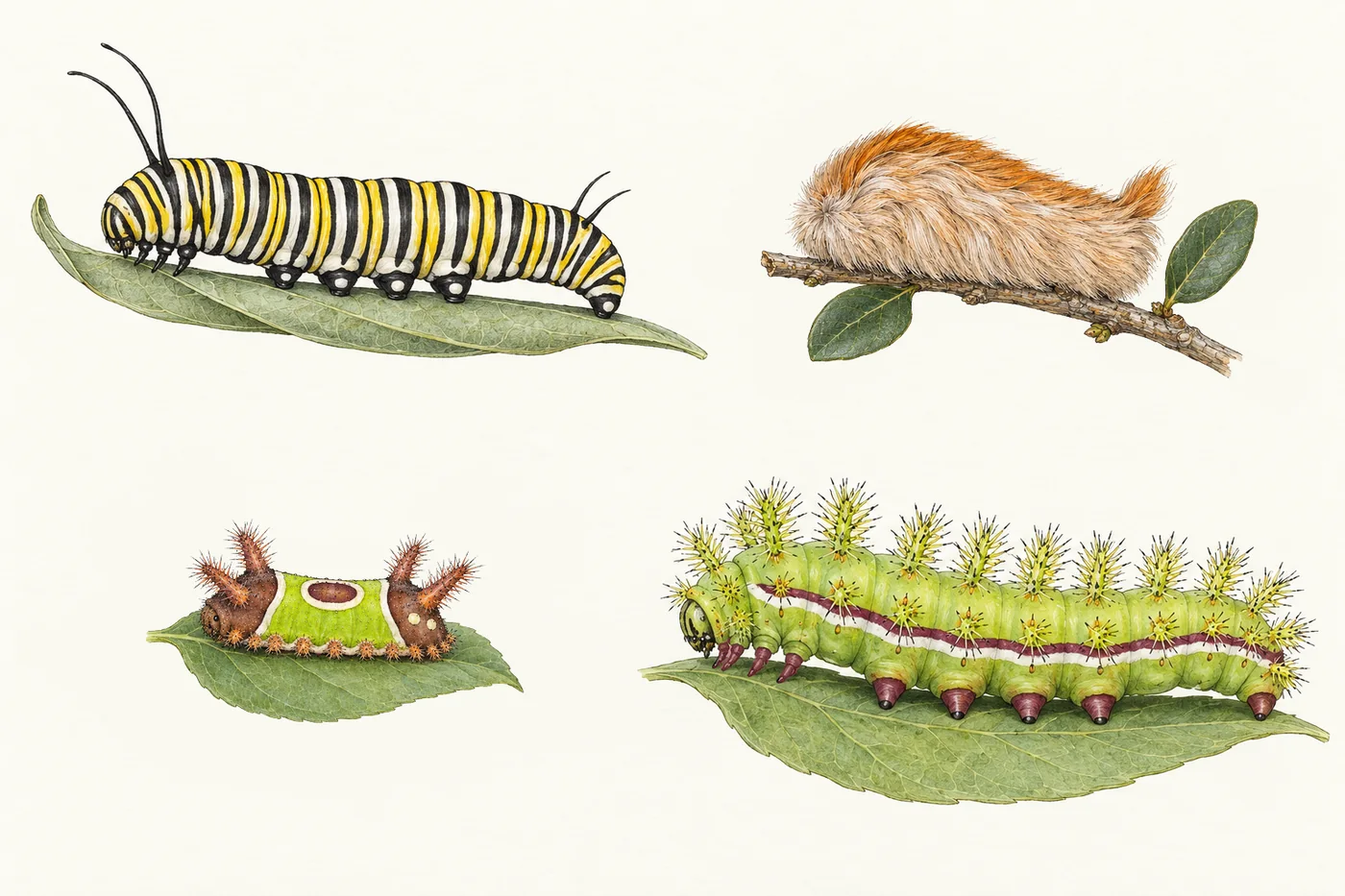
- Monarch: safe to hold, gently and brieflyEven black, white and yellow bands and two pairs of soft black feelers. Fine touch hairs, but no stinging spines. Found on milkweed. After it's a few days old, hold it as little as possible until it's over an inch long, and leave it alone when it's still, molting or hanging in a J.
- Asp (southern flannel moth): never touchA furry teardrop; Texas A&M says they "resemble a tuft of cotton or fur." Hidden spines give intense, throbbing pain within minutes. Texas poison-center stings peak in July and in October and November.
- Saddleback: never touchA brown body with a bright green "saddle blanket" and an oval purplish-brown spot in the middle. Spiny horns at both ends sting.
- Io moth: never touchPale green, with a maroon stripe edged in white along each side, and clusters of branched spines that sting.
Smooth and stripy on milkweed: yes. Fuzzy or spiky: no. Get a grown-up.
If someone is stung, or gets sap in an eye
- Stung: brush the caterpillar off with a stick or tool, not bare hands. Press tape on the spot, sticky side down, pull it off, and repeat with fresh tape. Wash with soap and water, then use an ice pack. Ask Poison Help or your pediatrician before giving an antihistamine.
- Get care right away for a sting near an eye, hives spreading over the body, or severe pain. Call 911 for trouble breathing, swelling of the face or lips, or fainting.
- Milkweed sap in an eye: don't rub, and take out any contact lens. Rinse with room-temperature water for 10 to 15 minutes and call Poison Help. If pain, blurry vision, light sensitivity or redness starts, even hours later, get an eye exam that day and tell the doctor "milkweed sap."
- Poison Help: 1-800-222-1222. It's free, open 24 hours, and reaches the Texas Poison Center Network.
Sources: Texas A&M AgriLife Extension (ENT-3010 and 2025 guidance); poison.org; Lu et al., J. Emerg. Med. (2026) on delayed eye symptoms; Forrester, Texas Department of State Health Services, Wilderness & Environmental Medicine (2018): 3,484 asp stings reported to Texas poison centers from 2000 to 2016, 59% in October and November, 91% at home. Don't spray Bt for asps near milkweed: Texas A&M notes it also kills the non-stinging caterpillars. First aid is general guidance; a medical reviewer checks this page before it publishes.
Draft, awaiting expert review. Drawn with AI assistance (ChatGPT) from a written anatomy spec and checked against it. A lepidopterist or horticulturist reviews every plate that identifies a living thing before the guide ships.