Is my monarch male or female?
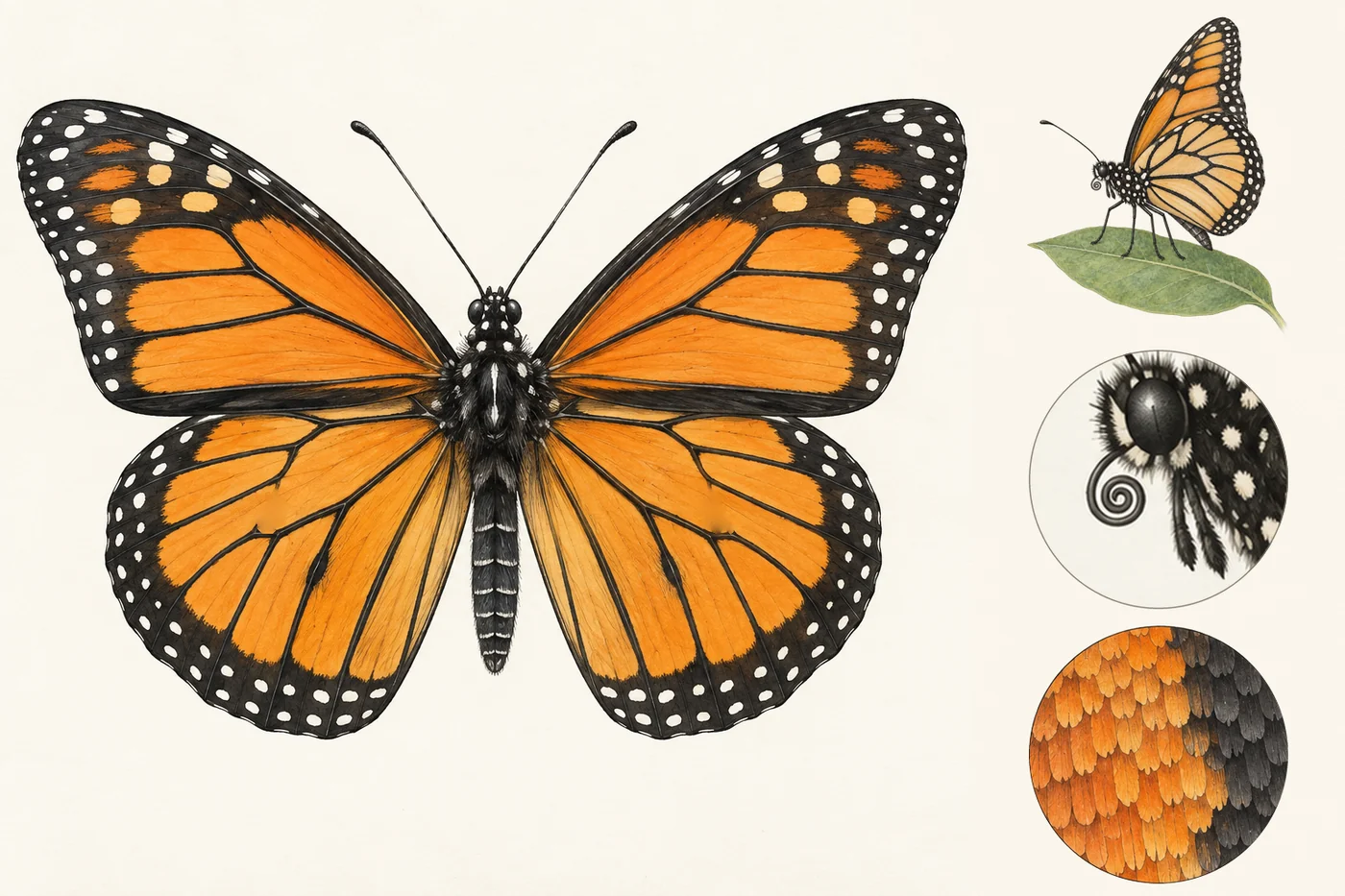
Look at the hind wings. A male monarch has a black spot on a vein on each hind wing; a female has none.1 That is the whole test, and it works on any adult monarch whose wings are open. Monarch Watch, at the University of Kansas, gives two more signs: males have “a pair of claspers on the end of the abdomen,” and females “often look darker than males and have wider veins on their wings.”1
The spot
Monarch Watch’s description: the male has “a black spot (see photo) on a vein on each hind wing that is not present on the female.”1 On an open-winged monarch, the hind wings are the lower pair; the spot sits on one of the black veins, one on each side.
What the spot is: “These spots are made of specialized scales which produce a chemical used during courtship” in many butterfly and moth species, “although such a chemical does not seem to be important in Monarch courtship.”1 So the spot is made of scales that produce a courtship chemical in many butterflies and moths, and in monarchs, in Monarch Watch’s words, that chemical does not seem to be important in courtship. It still tells you the sex at a glance.
The claspers and the veins
“On male Monarch butterflies you can see a pair of claspers on the end of the abdomen. These appendages grasp the female during mating.”1 You need a close look at the tip of the body, which is easier on a butterfly standing on a finger than on one at a flower.
The third sign is a matter of degree: females “often look darker than males and have wider veins on their wings.”1 Often, not always. Use the veins to confirm what the spot already told you, not on their own.
When a child can look
On a butterfly you raised, wait. Monarch Watch says to allow “3-4 hours” for the wings to dry before handling, and that “it is best to wait 24 hours to release them”; the Monarch Larva Monitoring Project says release “24 hours after eclosion.”23 The next day, let it stand on a finger; a child “will be able to feel the feet, or tarsi, clinging to their skin,” in the words of a Smithsonian classroom lesson.4 With the wings open on a finger in the sun, the spots are easy to see.
If it needs holding, Monarch Watch’s rule is to “always hold all 4 wings at once in their vertical position,” and it adds: “Despite what you may have heard, it is alright to handle Monarchs, even touching their wings, if you do it carefully. … A few scales may come off during handling, but this will not hurt the butterfly.”2 That is a grown-up’s hold. For a child, standing on a finger is enough.
In the yard, a monarch feeding at a flower with its wings open will show the spots, and a photograph zoomed in afterward is often the easiest way to check.
What you can’t tell
No source we use gives a way to tell a caterpillar’s or a chrysalis’s sex by eye, so we don’t offer one. The answer arrives with the butterfly.
Why it is worth writing down
Once a child can tell them apart, it becomes part of the record: “a girl, let go on Tuesday.” The observation journal in each city edition has a line for it.
How we know. The three signs and the note on courtship are Monarch Watch’s, from its Sexing Monarchs page, which carries a photograph of each. Handling times come from Monarch Watch and the Monarch Larva Monitoring Project. Our butterfly plate, which labels the spots, is marked “draft, awaiting expert review” until a lepidopterist has checked it; until then, use Monarch Watch’s photograph.
Footnotes
-
Monarch Watch, University of Kansas, Sexing Monarchs, https://monarchwatch.org/biology/sexing.htm ↩ ↩2 ↩3 ↩4 ↩5 ↩6
-
Monarch Watch, University of Kansas, Rearing Monarchs, https://www.monarchwatch.org/rear/ ↩ ↩2
-
Monarch Larva Monitoring Project (Monarch Joint Venture), Frequently Asked Questions, https://mlmp.org/mlmp-resources/frequently-asked-questions ↩
-
Smithsonian Institution, Flight of the Butterflies Educator Guide, Grades K-2 lesson “Getting to Know Your Caterpillars,” https://www.si.edu/Content/SE/Educator%20Guides/Flight%20of%20the%20Butterflies_Educator%20Guide.doc ↩