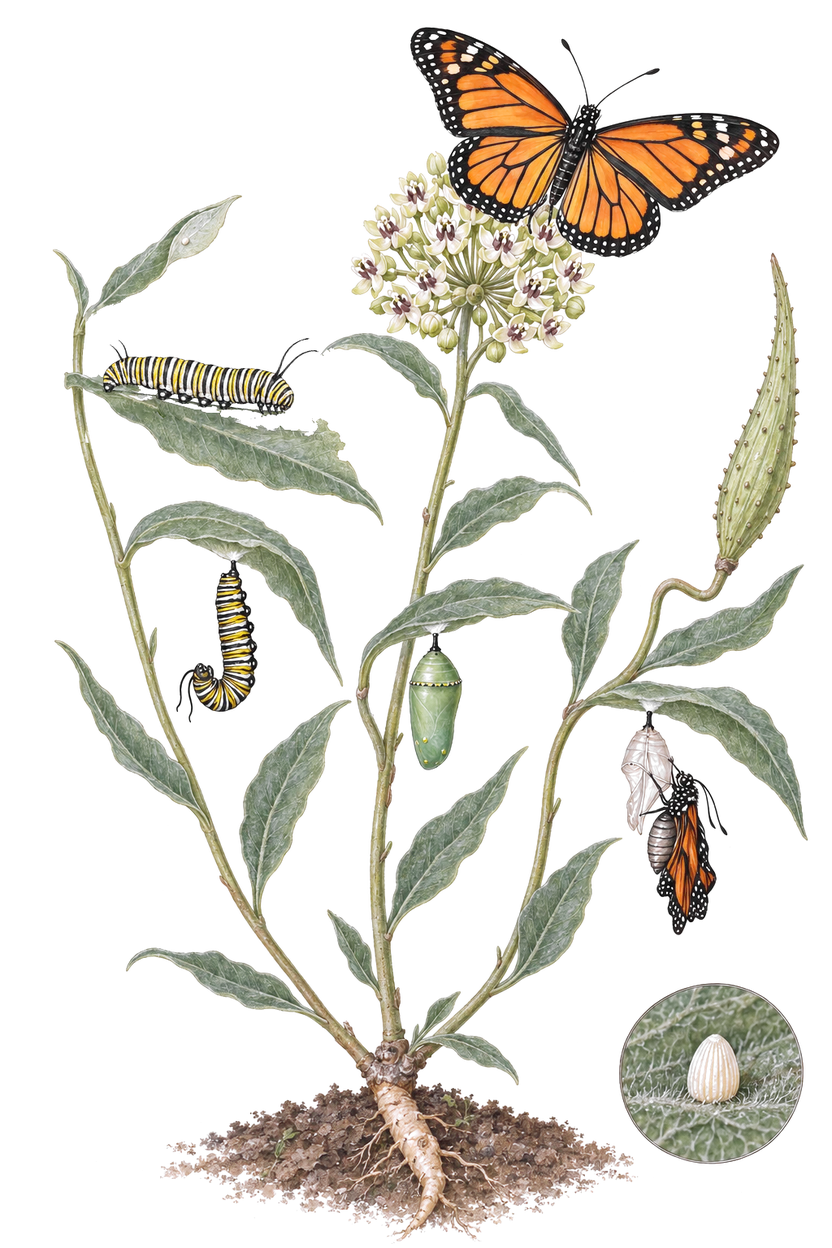
The monarch life cycle, for kids
For a grown-up to read aloud to a child of about four to eight. Print it if you like. Nothing on this page asks for anything from you or your child, and every line is true; the sources are at the bottom, for the grown-up.
The egg
A monarch mother lands on a milkweed plant and taps the leaf with her feet.
Her feet can taste. They tell her it’s milkweed.
She usually lays one egg on each plant, often under a leaf near the top.
The egg is as small as the head of a pin. In a few days, it hatches.
The caterpillar
The first thing the baby caterpillar eats is its own eggshell.
After that, it eats milkweed and nothing else.
It eats so much, and grows so fast, that its skin gets too tight. So it splits its skin and crawls out. It does that four times.
Each time, it is a little bigger. By the end it is about as long as a paperclip, and it weighs almost two thousand times what it did when it hatched.
The two long black whips, one pair at the front and one at the back, are feelers for touch. They are not antennae, and they can’t sting.
A monarch caterpillar is smooth and stripy, and it doesn’t sting. Once it is three or four days old, it can walk onto a clean finger.
Until it is longer than an inch, we touch it as little as we can. And we never touch one that is shedding its skin.
If it is holding very still, it’s busy changing its skin. We look with our eyes, not our fingers.
Milkweed has white milk inside. It stays away from our eyes and our mouths.
The chrysalis
When it is big enough, the caterpillar walks away from the milkweed. It can walk a long way, as far as ten of a grown-up’s biggest steps.
It spins a little pad of silk, holds on with its back feet, and hangs upside down in the shape of the letter J.
Then it sheds its skin one last time. Underneath is a smooth green case with a row of gold dots. That is the chrysalis.
A chrysalis is not a cocoon. Moths spin cocoons out of silk. A butterfly’s chrysalis is its own hard skin.
Inside, it isn’t all soup. Scientists looked inside a cousin butterfly’s chrysalis and saw its breathing tubes were still there.
Nobody knows for sure what the gold dots are for.
On the last day, the case turns clear, and you can see orange and black wings inside.
The butterfly
The butterfly pushes out and hangs from the empty case. Its wings are small and crumpled and wet.
It pumps them full until they are big and flat. Then it waits for them to dry.
Its tongue comes out in two halves. It zips them together into one straw for drinking.
Today, we say hello with our eyes. Tomorrow its wings are dry, and it can stand on a finger.
A boy monarch has a black dot on each back wing. A girl doesn’t.
The long trip
In summer, a monarch butterfly lives for a few weeks. It drinks from flowers, lays eggs on milkweed, and its children carry on.
In fall, the last monarchs of the year are different. Most of them don’t lay eggs. They fly all the way to mountain forests in Mexico, where they have never been.
Those monarchs can live all winter. In spring they fly north again and lay their eggs on milkweed in Texas and the other southern states.
Monarchs that live west of the Rocky Mountains spend the winter in California instead, in trees near the sea.
Then their children fly farther north, and their grandchildren farther still. And it starts again.
For the grown-up: how we know
Every line above restates a fact that has a source. The read-aloud lines carry no numbers; these do. Three lines use a comparison in place of a number: “the head of a pin” stands for an egg 1.2 mm tall, “a paperclip” for a caterpillar 25 to 45 mm long, and “ten of a grown-up’s biggest steps” for 10 meters.
- Egg-laying monarchs tap the leaf “with fore-tarsi,” and the taste organs on those front feet respond to milkweed.1 “Monarch females usually lay a single egg on a milkweed plant, often on the bottom of a leaf near the top of the plant.” The egg is 1.2 mm high and 0.9 mm wide, and hatches in “3-5 days, depending on the temperature.”2
- “After hatching, the larva eats its eggshell.” Milkweeds are “the required larval host plants for the monarch butterfly.”23
- “Monarchs have five larval instars and grow to almost 2,000 times their original mass.” A fifth instar is 25 to 45 mm long.2 Five instars means four sheddings before the last one that makes the chrysalis.
- The filaments “are not antennae” and “function as sense organs.”4
- Monarch Watch: “Larvae can be handled safely with fingers after they are about three to four days old, but it is best to handle them as little as possible until they are over an inch long,” and “Larvae of any size should not be handled when they are molting.”5 None of the monarch groups we read describes the caterpillar stinging, and classroom lessons have children aged five to eight hold them.6
- Fifth instars “will travel as far as 10 meters away!”7 They form “a silk pad” and hang “upside down in a J shape before shedding its skin one last time to expose the bright green chrysalis.”2
- “Butterflies molt into a chrysalis, which is a hard exoskeleton covering that protects the developing butterfly beneath,” while moths “spin silk around themselves and molt inside the silk casing.”8
- X-ray scans of painted lady chrysalises, a cousin of the monarch, showed “less remodelling of the tracheal system than previously expected.”9 Monarch Joint Venture lists several ideas for the gold dots and settles on none.10
- “Just before the monarchs emerge, their black, orange, and white wing patterns are visible through the pupa covering.”2 The new butterfly “pumps fluid to its wings to give them shape, and spends several hours drying.”2 The tongue’s two halves “are united after the insect emerges from the pupa.”11
- Wings: allow “3-4 hours” to dry before handling, and “it is best to wait 24 hours to release them.”5 Males have “a black spot on a vein on each hind wing that is not present on the female.”12
- Milkweed latex “is painful and can even cause corneal damage if it is rubbed into eyes.”13
- “Adults in summer generations live from two to five weeks.” “Most monarch butterflies that emerge after about mid August in the eastern U.S. enter reproductive diapause (do not reproduce) and begin to migrate south in search of the overwintering grounds where they have never been before.” The migratory generation “can live for up to nine months.” “In March, this generation begins the journey north into Texas and southern states, laying eggs.”214
- West of the Rockies, monarchs winter “along the California coast” and “roost for the winter in eucalyptus, Monterey cypress, Monterey pine, and other trees.”14
The longer version, with every number, is The monarch life cycle. The safety rules for small hands, in full, are in the Gentle Hands chapter of each city edition.
Footnotes
-
Physiological Entomology, Baur et al. (1998), contact chemoreception in ovipositing monarch butterflies, https://doi.org/10.1046/j.1365-3032.1998.2310007.x ↩
-
Monarch Joint Venture, Life Cycle, https://monarchjointventure.org/monarch-biology/life-cycle ↩ ↩2 ↩3 ↩4 ↩5 ↩6 ↩7
-
The Xerces Society, USDA-NRCS and Monarch Joint Venture, Pollinator Plants of the Central United States: Native Milkweeds, https://xerces.org/sites/default/files/2018-05/13-037_01_XercesSoc_NativeMilkweeds_Central-US_web.pdf ↩
-
Oberhauser and Kuda (1997), A Field Guide to Monarch Caterpillars, University of Minnesota (hosted by Monarch Joint Venture), https://mjv.nyc3.cdn.digitaloceanspaces.com/user-icons/field-guide-monarch-caterpillars-danaus-plexippus.pdf ↩
-
Monarch Watch, University of Kansas, Rearing Monarchs, https://www.monarchwatch.org/rear/ ↩ ↩2
-
Smithsonian Institution, Flight of the Butterflies Educator Guide, Grades K-2 lesson “Getting to Know Your Caterpillars,” https://www.si.edu/Content/SE/Educator%20Guides/Flight%20of%20the%20Butterflies_Educator%20Guide.doc ↩
-
Monarch Joint Venture, Egg/Larva (FAQ), https://monarchjointventure.org/faq/egg-larva ↩
-
Monarch Joint Venture, What’s the difference between a chrysalis and a cocoon? (FAQ), https://monarchjointventure.org/faq/monarch-biology/whats-the-difference-between-a-chrysalis-and-a-cocoon ↩
-
Journal of the Royal Society Interface, Lowe et al. (2013), X-ray micro-CT of painted lady metamorphosis, https://doi.org/10.1098/rsif.2013.0304 ↩
-
Monarch Joint Venture, Chrysalis gold dots (FAQ), https://monarchjointventure.org/faq/monarch-biology/chrysalis-gold-dots ↩
-
Journal of the Royal Society Interface, Zhang et al. (2018), proboscis self-assembly, https://doi.org/10.1098/rsif.2018.0229 ↩
-
Monarch Watch, University of Kansas, Sexing Monarchs, https://monarchwatch.org/biology/sexing.htm ↩
-
Monarch Joint Venture, Rearing Monarchs: A guide to raising monarchs in your home or classroom, https://loudounwildlife.org/wp-content/uploads/2017/03/Monarch_Rearing_Tips.pdf ↩
-
Monarch Joint Venture, Monarch Migration, https://monarchjointventure.org/monarch-biology/monarch-migration ↩ ↩2