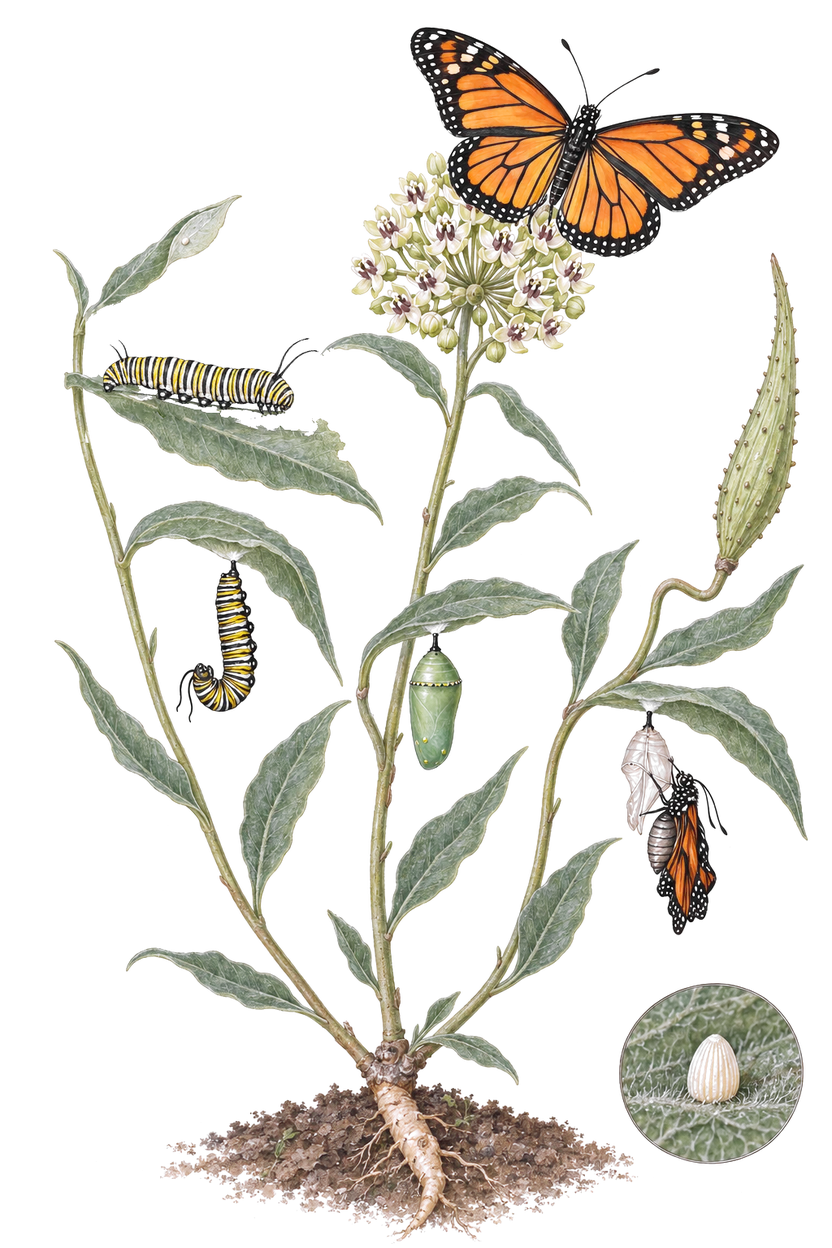
The monarch life cycle
In warm weather a monarch goes from egg to butterfly in about 30 days: three to five days as an egg, nine to fourteen as a caterpillar that grows through five sizes, and eight to fifteen as a chrysalis.12 In a cool spring every stage runs longer; Monarch Joint Venture says the first spring generation “may take them up to 40 or 50 days, or even more.”1 Here is each stage, with its sizes and days and where the numbers come from.
The egg, about days 1 to 4
Monarch Joint Venture: “Monarch females usually lay a single egg on a milkweed plant, often on the bottom of a leaf near the top of the plant.”1 Monarch Watch gives the reason: “A female will usually lay only one egg per milkweed plant to ensure enough food for each larva.”3 Before she lays, she checks the leaf with her feet. Egg-laying monarchs tap the leaf “with fore-tarsi,” and the taste organs on those front feet respond to milkweed.4
The egg is 1.2 millimeters high and 0.9 wide, and it hatches in three to five days, depending on temperature.1 Monarch Watch says “the eggs hatch about four days after they are laid”; the Fish and Wildlife Service gives two to five.25 Most eggs never become butterflies: “Less than 10% of monarch eggs reach adulthood (with some studies as low as 2%).”6
The caterpillar, about days 4 to 16
Its first meal is its own eggshell.1 After that it eats milkweed and nothing else; the Xerces Society calls milkweeds “the required larval host plants for the monarch butterfly.”7 It grows through five sizes, each called an instar, shedding its skin between them, until it is “almost 2,000 times” its original mass.1 The five sizes, from Monarch Joint Venture: 2 to 6 mm, then 6 to 9, 10 to 14, 13 to 25, and 25 to 45 mm. The first four instars last “usually 1-3 days” each and the fifth “usually 3-5 days,” for nine to fourteen days of eating in all.1 Monarch Watch gives the same lengths and 10 to 14 days.2
Two things to know about the small ones. The University of Minnesota’s field guide: “The easiest way to distinguish larval instars is by head capsule and tentacle size, since these do not grow during an instar.” The black whips at each end “are not antennae” and “function as sense organs.”8 And the tiny first instar is the fragile one. Milkweed sap is held under pressure and sets sticky on contact with air; in one study on sandhill milkweed, 27 percent of first-instar caterpillars on intact leaves died stuck in it, against 2 percent on notched leaves.9 Older caterpillars have a trick: a fifth instar “often chew[s] a shallow notch in the petiole of the leaf they are eating,” and the leaf drops to hang vertically.8 Separate research on vein-cutting found that “vein cutting blocks latex flow to intended feeding sites.”10
How to find a caterpillar you can’t see: frass, the dark pellets under a plant. “They can also be located by the presence of their frass, or fecal matter.”8
The chrysalis, about days 16 to 27
A full-grown caterpillar often leaves the milkweed to find somewhere to hang, and “will travel as far as 10 meters away,” about 30 feet: a fence rail, window trim, the underside of a chair.61 There it spins a silk pad, grips it with its last pair of prolegs, and hangs head-down in the shape of a J. Then it sheds its skin one last time “to expose the bright green chrysalis.”1
A chrysalis is not a cocoon. Monarch Joint Venture: “Butterflies molt into a chrysalis, which is a hard exoskeleton covering that protects the developing butterfly beneath,” while moths “spin silk around themselves and molt inside the silk casing.”11 The gold dots are not metal. In the monarch’s close relatives, the shine comes from “over 200 double layers” of clear cuticle reflecting light, and no one knows for sure why it is there; Monarch Joint Venture lists several ideas, from camouflage to no purpose at all.1213
The stage lasts 8 to 15 days by Monarch Joint Venture’s count, 10 to 14 by Monarch Watch’s, and “one to two weeks” by the Fish and Wildlife Service’s.125 Inside, the popular story that the whole caterpillar dissolves into soup is too simple. X-ray scans of painted lady chrysalises showed the breathing tubes already in place twelve hours after the chrysalis formed, with “less remodelling of the tracheal system than previously expected,” and moths trained as caterpillars to avoid a smell still avoided it as adults, so parts of the nervous system survive too.1415 Those studies were on a painted lady and a moth, not on monarchs.
Near the end, “just before the monarchs emerge, their black, orange, and white wing patterns are visible through the pupa covering.”1 A day or so before, the case goes clear.16 A chrysalis that “has been very dark for over 48 hours” with no wing pattern showing is probably dead.17
The butterfly, about day 27, give or take a week
The butterfly pushes out, hangs from the empty case, and pumps fluid into its crumpled wings to stretch them.16 Soon after, it drips a reddish liquid: meconium, “waste materials from the chrysalis stage,” not blood.16 Its tongue comes out in two halves, “which are united after the insect emerges from the pupa.”18
Its wings need time. Monarch Watch says to allow “3-4 hours” for the wings to dry before handling, and that “it is best to wait 24 hours to release them”; the Monarch Larva Monitoring Project says release “24 hours after eclosion.”1719
Then it lives one of two lives. “Adults in summer generations live from two to five weeks.”1 The generation that emerges in late summer is different: “Most monarch butterflies that emerge after about mid August in the eastern U.S. enter reproductive diapause (do not reproduce) and begin to migrate south,” and “adults in the migratory generation can live for up to nine months.”20 The eastern monarchs raise about four generations a year, and Monarch Joint Venture says it is “generally the fourth generation” that flies to Mexico.120 Telling a male from a female is on its own page.
How we know. Stage lengths and sizes come from Monarch Joint Venture and Monarch Watch, which differ slightly, and from the Fish and Wildlife Service; each figure above carries its owner’s name. The anatomy comes from the University of Minnesota’s field guide to monarch caterpillars and the papers in the notes. Our life-cycle plate is drawn from these figures and is marked “draft, awaiting expert review” until a lepidopterist has checked it. The version for children says the same things in fewer words.
Footnotes
-
Monarch Joint Venture, Life Cycle, https://monarchjointventure.org/monarch-biology/life-cycle ↩ ↩2 ↩3 ↩4 ↩5 ↩6 ↩7 ↩8 ↩9 ↩10 ↩11 ↩12 ↩13
-
Monarch Watch, University of Kansas, Monarch Biology, https://monarchwatch.org/biology/ ↩ ↩2 ↩3 ↩4
-
Monarch Watch, University of Kansas, Rearing Monarchs, https://www.monarchwatch.org/rear/ ↩
-
Physiological Entomology, Baur et al. (1998), contact chemoreception in ovipositing monarch butterflies, https://doi.org/10.1046/j.1365-3032.1998.2310007.x ↩
-
U.S. Fish and Wildlife Service, Monarch (Danaus plexippus) species profile, https://www.fws.gov/species/monarch-danaus-plexippus ↩ ↩2
-
Monarch Joint Venture, Egg/Larva (FAQ), https://monarchjointventure.org/faq/egg-larva ↩ ↩2
-
The Xerces Society, USDA-NRCS and Monarch Joint Venture, Pollinator Plants of the Central United States: Native Milkweeds, https://xerces.org/sites/default/files/2018-05/13-037_01_XercesSoc_NativeMilkweeds_Central-US_web.pdf ↩
-
Oberhauser and Kuda (1997), A Field Guide to Monarch Caterpillars, University of Minnesota (hosted by Monarch Joint Venture), https://mjv.nyc3.cdn.digitaloceanspaces.com/user-icons/field-guide-monarch-caterpillars-danaus-plexippus.pdf ↩ ↩2 ↩3
-
Ecological Entomology, Zalucki, Brower and Alonso-M. (2001), latex and first-instar mortality on Asclepias humistrata, https://doi.org/10.1046/j.1365-2311.2001.00313.x ↩
-
Science, Dussourd and Eisner (1987), vein-cutting behavior, https://doi.org/10.1126/science.3616620 ↩
-
Monarch Joint Venture, What’s the difference between a chrysalis and a cocoon? (FAQ), https://monarchjointventure.org/faq/monarch-biology/whats-the-difference-between-a-chrysalis-and-a-cocoon ↩
-
Tissue & Cell, Steinbrecht (1985), structural gold in danaine pupae, https://doi.org/10.1016/0040-8166(85)90008-4 ↩
-
Monarch Joint Venture, Chrysalis gold dots (FAQ), https://monarchjointventure.org/faq/monarch-biology/chrysalis-gold-dots ↩
-
Journal of the Royal Society Interface, Lowe et al. (2013), X-ray micro-CT of painted lady metamorphosis, https://doi.org/10.1098/rsif.2013.0304 ↩
-
PLoS ONE, Blackiston, Silva Casey and Weiss (2008), memory retention through metamorphosis in Manduca sexta, https://doi.org/10.1371/journal.pone.0001736 ↩
-
Nature North, Monarch biology, http://naturenorth.com/summer/monarch/monarchF3.html ↩ ↩2 ↩3
-
Monarch Watch, University of Kansas, Rearing Monarchs, https://www.monarchwatch.org/rear/ ↩ ↩2
-
Journal of the Royal Society Interface, Zhang et al. (2018), proboscis self-assembly, https://doi.org/10.1098/rsif.2018.0229 ↩
-
Monarch Larva Monitoring Project (Monarch Joint Venture), Frequently Asked Questions, https://mlmp.org/mlmp-resources/frequently-asked-questions ↩
-
Monarch Joint Venture, Monarch Migration, https://monarchjointventure.org/monarch-biology/monarch-migration ↩ ↩2