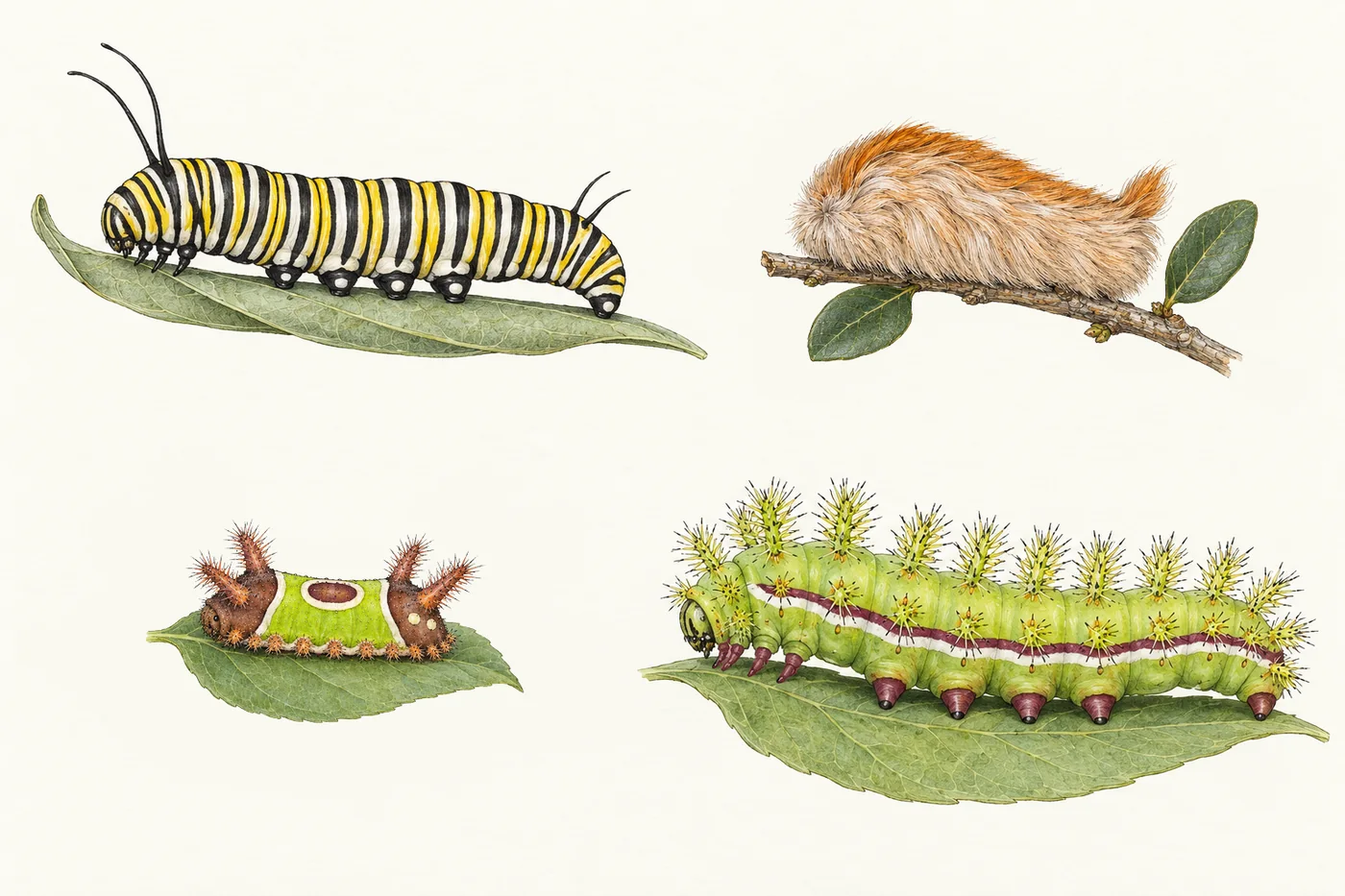
Monarch caterpillar or stinging caterpillar? A Texas guide
A monarch caterpillar is smooth, banded in yellow, white and black, with two pairs of soft black filaments, and it lives on milkweed. It does not sting. The Texas caterpillars that do sting are fuzzy, furry or spiny. The ones most often met in a yard, the asp above all, and the saddleback, the io moth, the buck moth and the hag moth, live on trees and shrubs.123 One fuzzy caterpillar does live on milkweed: the milkweed tussock moth, below, whose hairs can irritate skin.4
This page is general safety guidance, not medical advice. For poisoning or stings call Poison Help, 1-800-222-1222, free and open 24 hours; it reaches the Texas Poison Center Network.5 For trouble breathing, swelling of the face or lips, or fainting, call 911.2
The rule that covers everything
Molly Keck of Texas A&M AgriLife Extension: “A good rule of thumb is if a caterpillar looks ‘fuzzy’ — don’t touch it.”6 Wizzie Brown, the AgriLife Extension specialist for Travis County: “If you aren’t 100% sure what an insect is, it’s best not to touch it with your bare hands. If you want to pick a caterpillar up, put on some gloves.”7 The National Capital Poison Center: “As a general rule, brightly-colored caterpillars with spines, bristles, or a fuzzy appearance might be venomous and should not be touched.”8
For a child, the rule is shorter. Smooth and stripy, on milkweed, with two pairs of filaments: gently, once it is three or four days old, as little as possible until it is longer than an inch, and never while it is shedding its skin. The queen, with three pairs: look only. Fuzzy, furry, spiky or bristly: no. Freeze, don’t touch, and call a grown-up.19
Safe to hold, on milkweed: the monarch
The Lady Bird Johnson Wildflower Center: “Look for two sets of fine filaments, one pair at the front and one at the rear.” Its bands of yellow, white and black “generally appear similar in thickness.”1 None of the monarch groups we read describes the caterpillar stinging or irritating skin, and museum and university classroom lessons have children aged five to eight hold them.10 Monarch Watch’s handling limits: “Larvae can be handled safely with fingers after they are about three to four days old, but it is best to handle them as little as possible until they are over an inch long,” and “Larvae of any size should not be handled when they are molting.”9 The thing to watch is not the caterpillar but the milky sap on the plant, which should stay away from eyes and mouths.11
Look only, on milkweed: the queen
Texas has a look-alike whose caterpillars also eat milkweed. The Wildflower Center, on the queen: “Look for three sets of filaments, two longer pairs toward the front and a shorter pair near the rear.”1 No source we found says queen caterpillars are safe to touch, so leave them alone.
Fuzzy, on milkweed: the milkweed tussock moth
A tufted black, orange and white caterpillar on milkweed is the milkweed tussock moth. It eats milkweed too, and it belongs there. Clemson Extension: “The hairs on this caterpillar may cause a stinging irritation to skin, so think twice before grabbing them,” and it advises handling them “with gloved hands as the caterpillars have urticating hairs that can result in an uncomfortable rash.”4 An uncomfortable rash, in Clemson’s words, and a different injury from an asp sting. Gloves if you move it, or leave it.
Never touch
- The asp, the southern flannel moth caterpillar. Texas A&M: they “resemble a tuft of cotton or fur,” yellow or gray to reddish-brown, 1 to 1½ inches, and “the head and legs are not visible from above.”23 Where: “shade trees and shrubbery around homes, schools, and in parks,” on oaks, pecan, elm, hackberry and dwarf yaupon; they “can drop from trees.”26 When: “more common in the fall”; Texas poison-center stings peaked in July (12%) and October to November (59%), with 91% at the patient’s own home.212 The sting: “Intense, throbbing pain develops immediately or within five minutes of contact,” sometimes with pain in the armpit, red spots, headache, nausea or vomiting; “pain usually subsides within an hour.”2
- Io moth. “Pale green with yellowish and maroon stripes edged with white along each side of the body,” with “clusters of stiff spines,” up to about 2½ inches.3 “Larvae should not be touched.”13
- Buck moth. “Resembles the io moth caterpillar but is purple-black with a reddish head and lacks the body stripes”; on oaks, in spring.36
- Saddleback. “A brown body marked with a bright green area resembling saddle blanket with an oval purplish-brown spot in its center,” with spiny horns front and back, about an inch.3
- Hag moth. About ⅝ inch, with “nine pairs of curved and twisted fleshy projections arising from the sides of the body bearing stinging hairs.”3
- Spiny oak slug and hickory tussock moth are on Texas A&M’s 2025 list of stinging caterpillars.7 We have not yet found sourced descriptions of them for Texas, so we don’t describe them here.
The asp is the one to know. The Texas poison-center study counted 3,484 asp stings reported from 2000 to 2016, and 93 percent of the patients “were known or expected to have no or at most minor clinical effects.”12 Painful, common, and usually at home. The pain usually eases within an hour; the red spots can last a day or so.2 The October-to-November peak overlaps the fall monarch season, which is a reason to reread this page with a child in September.
If someone is stung
Brush the caterpillar off with a stick or tool, not bare hands.8 Press tape on the spot, sticky side down, pull it off, and repeat with fresh tape.8 Wash with soap and water, then use an ice pack.87 Ask Poison Help or your pediatrician before giving an antihistamine.7 Get care right away for a sting near an eye, hives spreading over the body, or severe pain.72 Call 911 for trouble breathing, swelling of the face or lips, or fainting.2
Poison Help: 1-800-222-1222. Free, 24 hours, reaches the Texas Poison Center Network.5 Trouble breathing, swelling of face or lips, or fainting: call 911.2
A note for the grown-up with the sprayer
Don’t spray for asps near the milkweed. Texas A&M notes that the organic caterpillar spray Bt “will also kill all the non-stinging or ‘good’ caterpillars,” and its fact sheet lists permethrin among the sprays “labeled for control of caterpillars.”62 An asp on the oak is a reason for gloves and a stick, not for a spray that reaches the milkweed bed.
About the pictures
Our side-by-side plate of the monarch and the stinging caterpillars was drawn from these written descriptions and is marked “draft, awaiting expert review” until a lepidopterist has checked it. Until then, use Texas A&M’s own photographs, on its fact sheet and its field guide, to identify a caterpillar you are unsure about.23
How we know. Descriptions and habits: Texas A&M AgriLife Extension’s fact sheet on stinging caterpillars, its Field Guide to Common Texas Insects, and its news articles of 2020 and 2025. Sting counts: a 2018 study of Texas poison-center reports by an author at the Texas Department of State Health Services. First aid: the National Capital Poison Center and Texas A&M. The monarch and queen: the Lady Bird Johnson Wildflower Center. The milkweed tussock moth: Clemson Extension. The io moth: the Florida State Collection of Arthropods.
Footnotes
-
Lady Bird Johnson Wildflower Center, Monarch vs. Queen, https://www.wildflower.org/magazine/fauna/monarch-vs-queen ↩ ↩2 ↩3 ↩4
-
Texas A&M AgriLife Extension (Insects in the City), Puss caterpillars and other stinging caterpillars, ENT-3010, https://citybugs.tamu.edu/factsheets/biting-stinging/others/ent-3010/ ↩ ↩2 ↩3 ↩4 ↩5 ↩6 ↩7 ↩8 ↩9 ↩10 ↩11 ↩12
-
Texas A&M AgriLife Extension, Field Guide to Common Texas Insects: Puss caterpillar or asp, https://texasinsects.tamu.edu/puss-caterpillar-or-asp/ ; and Luna, io, imperial, cecropia and polyphemus moths, https://texasinsects.tamu.edu/luna-io-imperial-cecropia-polyphemus-moths/ ↩ ↩2 ↩3 ↩4 ↩5 ↩6 ↩7
-
Clemson Cooperative Extension, Home & Garden Information Center, Question of the Week: Milkweed tussock moth caterpillar, https://hgic.clemson.edu/question-of-the-week-milkweed-tussock-moth-caterpillar/ ; and Milkweed Tussock Moth Caterpillars, https://hgic.clemson.edu/milkweed-tussock-moth-caterpillars/ ↩ ↩2
-
Missouri Poison Center, Is this a poison? Milkweed (1-800-222-1222 reaches the local poison center anywhere in the United States), https://missouripoisoncenter.org/is-this-a-poison/milkweed/ ↩ ↩2
-
Texas A&M Stories, Stinging caterpillar season has arrived in Texas (11 May 2020), https://stories.tamu.edu/news/2020/05/11/stinging-caterpillar-season-has-arrived-in-texas/ ↩ ↩2 ↩3 ↩4
-
Texas A&M AgriLife Today, Start looking out for stinging caterpillars (29 May 2025), https://agrilifetoday.tamu.edu/2025/05/29/start-looking-out-for-stinging-caterpillar/ ↩ ↩2 ↩3 ↩4 ↩5
-
National Capital Poison Center (poison.org), Caterpillar stings, https://www.poison.org/articles/caterpillar-stings ↩ ↩2 ↩3 ↩4
-
Monarch Watch, University of Kansas, Rearing Monarchs, https://www.monarchwatch.org/rear/ ↩ ↩2
-
Smithsonian Institution, Flight of the Butterflies Educator Guide, Grades K-2 lesson “Getting to Know Your Caterpillars,” https://www.si.edu/Content/SE/Educator%20Guides/Flight%20of%20the%20Butterflies_Educator%20Guide.doc ↩
-
Monarch Joint Venture, Rearing Monarchs: A guide to raising monarchs in your home or classroom, https://loudounwildlife.org/wp-content/uploads/2017/03/Monarch_Rearing_Tips.pdf ↩
-
Wilderness & Environmental Medicine, Forrester (2018), Megalopyge opercularis Caterpillar Stings Reported to Texas Poison Centers, https://pubmed.ncbi.nlm.nih.gov/29625901/ ↩ ↩2
-
Florida State Collection of Arthropods, Urticating caterpillars in Florida: 1. Io moth, Automeris io, https://thefsca.org/publications/circulars/urticating-caterpillars-in-florida-1-lo-moth-automeris-io/ ↩