Monarch caterpillar look-alikes
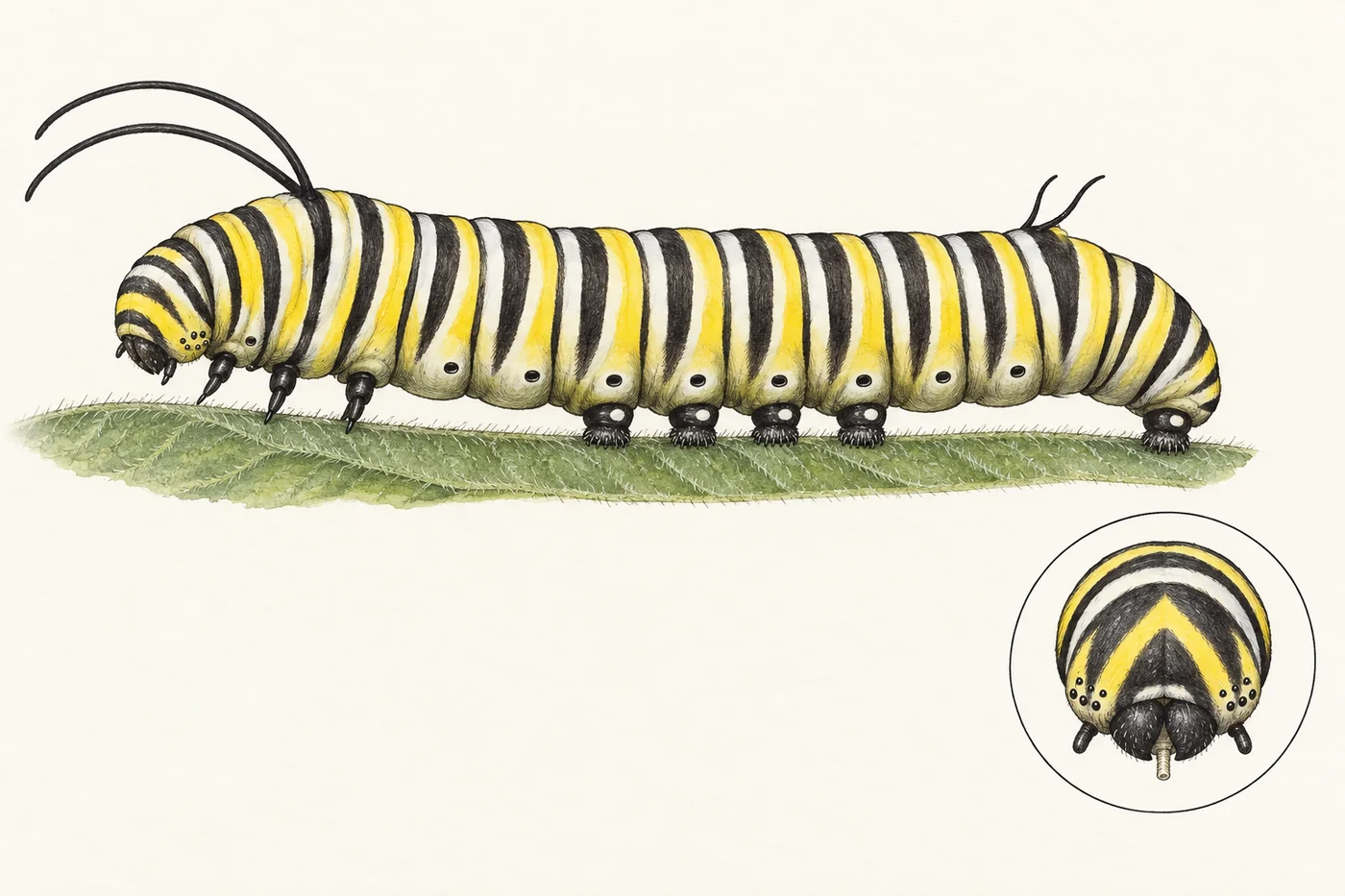
A monarch caterpillar is smooth, banded in yellow, white and black, with two pairs of soft black filaments, one pair at the front and one at the rear, and it is on milkweed.1 The three caterpillars most often mistaken for it are the queen, which has three pairs of filaments and also eats milkweed; the black swallowtail, which is green with black bands and yellow spots and eats parsley, dill and fennel; and the milkweed tussock moth, which is fuzzy.123 The first test is the plant. A monarch caterpillar feeds on milkweed and on nothing else; the one exception is a full-grown one, which is “often found far from milkweed plants” as it looks for a place to hang.4
Start with the plant
The Xerces Society, writing with the USDA and Monarch Joint Venture: “Milkweeds are the required larval host plants for the monarch butterfly (Danaus plexippus),” and “Female monarchs lay their eggs on milkweeds and once hatched, caterpillars feed on the plants for up to two weeks before forming chrysalises.”5 So a striped caterpillar on your parsley is not a monarch, whatever it looks like. A smooth striped caterpillar on milkweed is a monarch or a queen, and the filaments settle which.
The monarch
The Lady Bird Johnson Wildflower Center: “Look for two sets of fine filaments, one pair at the front and one at the rear.” Its bands “of yellow, white and black” are ones “that generally appear similar in thickness.”1 The University of Minnesota’s field guide says what the filaments are: “Monarch larvae have two sets of tentacles or filaments (front and back); these are not antennae, and are not found on all butterfly larvae. They function as sense organs.”6 A full-grown fifth instar is 25 to 45 millimeters long.4
The smallest ones are harder to name. The field guide’s advice for telling a caterpillar’s age applies here too: “The easiest way to distinguish larval instars is by head capsule and tentacle size, since these do not grow during an instar.”6 If you can’t tell, wait a few days; it will grow into its pattern.
The queen: three pairs of filaments
The queen is a close relative, and its caterpillars eat milkweed too; a north Texas study followed the eggs of both species on the same site.7 The Wildflower Center: “Look for three sets of filaments, two longer pairs toward the front and a shorter pair near the rear.”1 In Central Texas, the Center adds, “though queen butterflies can be found spring, summer and fall in Central Texas, both monarchs and queens are usually only found together during the monarch migrations of spring and fall.”1 No source we found says queen caterpillars are safe to touch, so look at that one and leave it be.
The black swallowtail: green, black and yellow, and not on milkweed
This is the one that gets reported as a “monarch on my parsley.” The University of Wisconsin–Madison’s extension service: “Larval host plants include a variety of species in the carrot family (Apiaceae),” and “Cultivated dill, parsley, fennel, celery, caraway, and carrot are common food sources in backyard gardens.”2 The young ones don’t look like monarchs at all: “The first instar larvae are spiny and mostly black with a whitish saddle, mimicking bird droppings.” The older ones do, at a glance: “Older larvae (fourth and fifth instars) are green with transverse bands of black with yellow spots.”2 Green rather than white, yellow spots inside the black bands rather than yellow bands, no filaments, and the wrong plant.
One more tell, if it is disturbed: “All swallowtail larvae have an eversible horn-like organ behind the head known as the osmeterium (osmeteria, plural) that looks like a forked snake tongue,” which it pushes out when bothered.2 A monarch has nothing like it. The caterpillars “eventually grow up to 1½ to 2 inches long.”2 If you would rather keep your parsley and the caterpillar both, the same source suggests planting “dill or parsley that you are willing to let them eat.”2
The milkweed tussock moth: fuzzy, and on milkweed
A tufted black, orange and white caterpillar on milkweed is the milkweed tussock moth. It eats milkweed too, and it belongs there. It is the one look-alike to keep small hands off. Clemson Extension: “The hairs on this caterpillar may cause a stinging irritation to skin, so think twice before grabbing them,” and it advises handling them “with gloved hands as the caterpillars have urticating hairs that can result in an uncomfortable rash.”3 A rash, not a serious sting; gloves if you move it, or leave it.
The fuzzy rule, everywhere
The monarch is smooth. Anything fuzzy, furry, spiky or bristly is not a monarch, and the safe assumption is that it may sting. Molly Keck of Texas A&M AgriLife Extension: “A good rule of thumb is if a caterpillar looks ‘fuzzy’ — don’t touch it.”8 The National Capital Poison Center: “As a general rule, brightly-colored caterpillars with spines, bristles, or a fuzzy appearance might be venomous and should not be touched.”9 Texas has several that do sting; they are on Monarch caterpillar or stinging caterpillar? A Texas guide.
About the pictures
Our caterpillar plate is drawn from these written descriptions and is marked “draft, awaiting expert review” until a lepidopterist has checked it. Until then, the Wildflower Center’s monarch-versus-queen article and the extension pages in the notes carry photographs you can compare against.123
Footnotes
-
Lady Bird Johnson Wildflower Center, Monarch vs. Queen, https://www.wildflower.org/magazine/fauna/monarch-vs-queen ↩ ↩2 ↩3 ↩4 ↩5 ↩6
-
University of Wisconsin–Madison Division of Extension (Wisconsin Horticulture), Black swallowtail, Papilio polyxenes, https://hort.extension.wisc.edu/articles/black-swallowtail-papilio-polyxenes/ ↩ ↩2 ↩3 ↩4 ↩5 ↩6 ↩7
-
Clemson Cooperative Extension, Home & Garden Information Center, Question of the Week: Milkweed tussock moth caterpillar, https://hgic.clemson.edu/question-of-the-week-milkweed-tussock-moth-caterpillar/ ; and Milkweed Tussock Moth Caterpillars, https://hgic.clemson.edu/milkweed-tussock-moth-caterpillars/ ↩ ↩2 ↩3
-
Monarch Joint Venture, Life Cycle, https://monarchjointventure.org/monarch-biology/life-cycle ↩ ↩2
-
The Xerces Society, USDA-NRCS and Monarch Joint Venture, Pollinator Plants of the Central United States: Native Milkweeds, https://xerces.org/sites/default/files/2018-05/13-037_01_XercesSoc_NativeMilkweeds_Central-US_web.pdf ↩
-
Oberhauser and Kuda (1997), A Field Guide to Monarch Caterpillars, University of Minnesota (hosted by Monarch Joint Venture), https://mjv.nyc3.cdn.digitaloceanspaces.com/user-icons/field-guide-monarch-caterpillars-danaus-plexippus.pdf ↩ ↩2
-
Journal of Insect Conservation, Scott, Contreras, Stevenson, Hudman and Kopachena (2022), Survival of eggs to third instar of late-summer and fall-breeding monarch butterflies and queen butterflies in north Texas, https://doi.org/10.1007/s10841-022-00446-8 ↩
-
Texas A&M Stories, Stinging caterpillar season has arrived in Texas (11 May 2020), https://stories.tamu.edu/news/2020/05/11/stinging-caterpillar-season-has-arrived-in-texas/ ↩
-
National Capital Poison Center (poison.org), Caterpillar stings, https://www.poison.org/articles/caterpillar-stings ↩